Digging for clues about the North Pole’s past

TIM KALVELAGE

TIM KALVELAGE

TIM KALVELAGE
While sediment cores several meters long had been recovered on earlier expeditions in the central Arctic, there is no scientific consensus on how old the deposits actually are or whether sea ice ever completely disappeared in summer.
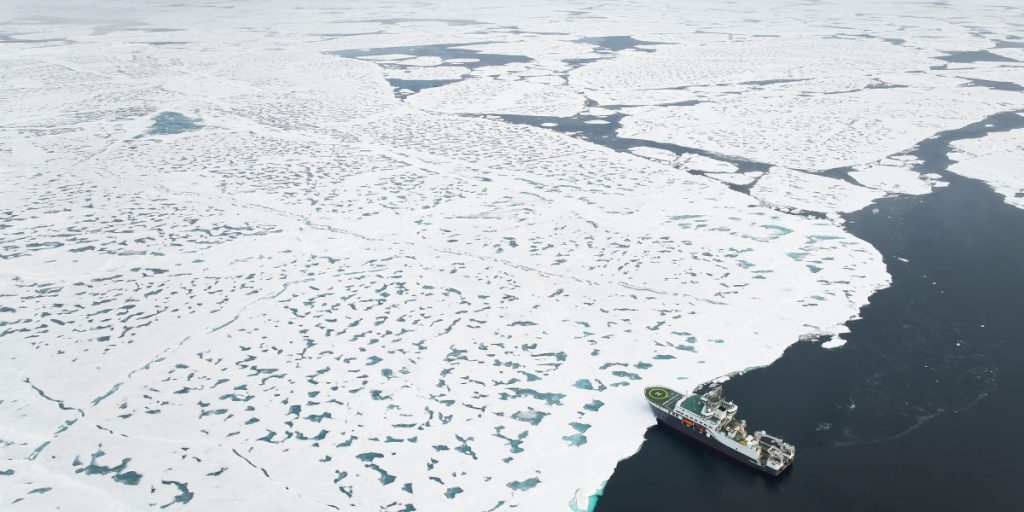
To decode the Arctic’s climate archive, Knies brought a team of experts from various disciplines onboard the Kronprins Haakon to dig deeper and obtain fresh samples they could subject to the latest analytical techniques.

TIM KALVELAGE

TIM KALVELAGE

TIM KALVELAGE
Some of this work was done while the researchers were still at sea. Now, at their home laboratories, they are finalizing their analysis of the seafloor samples. One important task is dating the sediments, which may be up to 2 million years old. The team uses a combination of methods to do this, including measuring magnetization, the decay of radioactive elements, and the exposure of mineral grains to sunlight before sinking to the depths. Once they can place them on a timeline, the materials in the cores will help researchers paint a picture of what the Arctic Ocean looked like in times that were warmer than today. For example, the presence or absence of the molecule IP25, which is produced exclusively by ice algae, could tell them how far the sea ice receded at a given time.

TIM KALVELAGE
At the end of the study, the team hopes to have data that could improve climate projections for a future ice-free “blue Arctic,” helping us understand how it could affect marine life and carbon storage, Atlantic Ocean circulation, or extreme weather events in Europe and North America.
Tim Kalvelage is a freelance science reporter based in Bremen, Germany, who focuses on climate, ocean, and polar research. He has been to the North Pole twice.
#Digging #clues #North #Poles