MKBHD Lines Up the Same Selfie on Every Galaxy S Generation to Show How Smartphone Cameras Have Changed
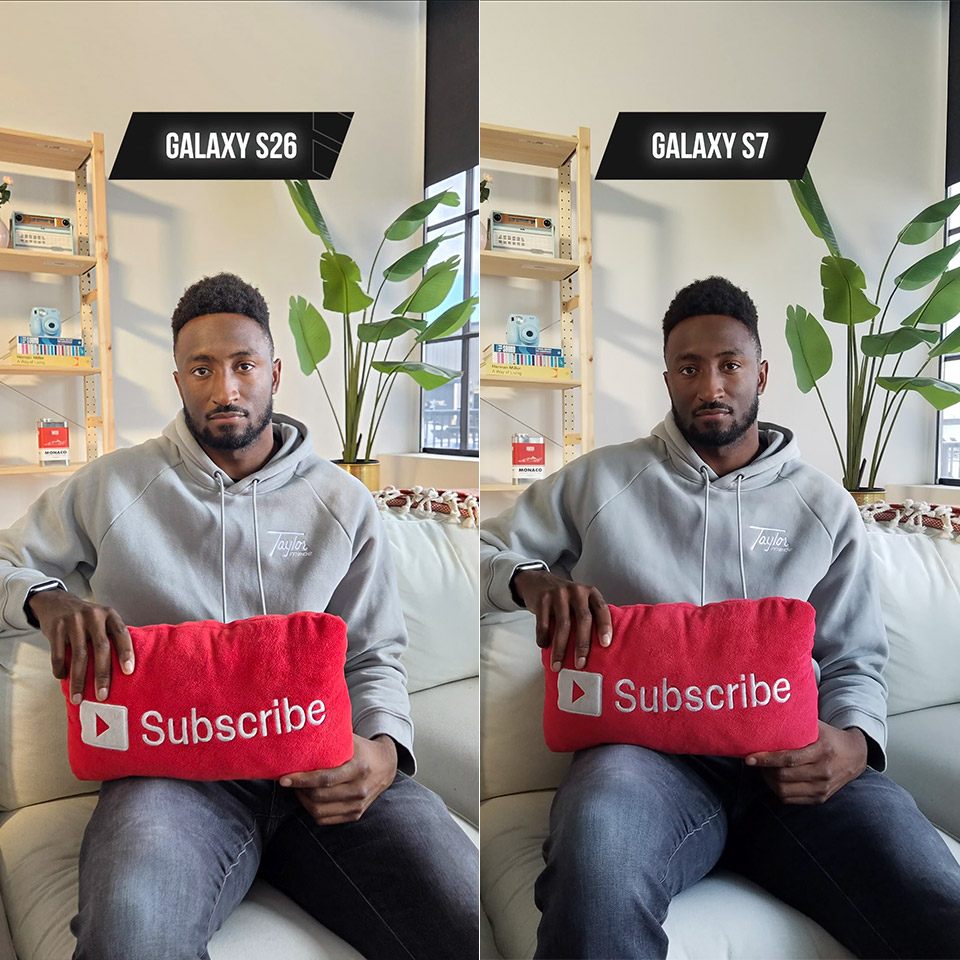
Just like his earlier iPhone generations comparison, Marques Brownlee decided to take the same selfie using the full line of Samsung Galaxy S models, from the original S1 to the spanking new S26. In each example, the framing remained fixed in place, and he depended on the front-facing camera with everything set to default, ensuring that any discrepancies between photos were due to the hardware and software in use at the time, rather than external variables. The lighting remained similar throughout, so any variances we notice down the line are solely down to the phone’s capacity to collect and process light.
Putting all of those individual shots together resulted in a video that Brownlee shared that shows a seamless ride from the S26 all the way back to the S1. At first glance, the newer phones appear to do an excellent job of displaying a nice spread of tones across the entire scene due to their aggressive high dynamic range (HDR) handling, which keeps highlights and midtones looking fairly balanced – but unfortunately flattens out the deeper shadows. As a result, viewers notice that the final look is pretty uniform, but also slightly compressed, implying that overall clarity triumphs over attempting to portray dramatic depth.
Sale

Samsung Galaxy S26 Ultra, Unlocked Android Smartphone, 512GB, Privacy Display, Galaxy AI, AI Camera…
- PRIVACY DISPLAY: Automatically hide your screen from those beside you. The built-in privacy display can be preset¹ to turn on when receiving…
- TYPE IT IN. TRANSFORM IT FAST: Enhance any shot in seconds on your smartphone by using Photo Assist² with Galaxy AI.³ Add objects, restore details…
- NIGHTS, CAPTURED CLEARLY: From gigs to city lights, record and capture moments after dark with clarity using Nightography so your photos and videos…
As the video progresses, the changes become more noticeable. The phones around the S22 and S10 have a much more natural contrast, which means they do a better job at bringing out face characteristics and making them appear crisp and clear while also maintaining a sense of actual lighting. Skin tones in those images also appeared nice, and background items retained their color far better than on any of the other phones. Things take a turn for the worst when the sequence hits the S20, as in that shot, the bright areas are entirely blown out, and face details lose their sharpness. That appears to be due to the phone’s relatively poor dynamic range management, paired with poor performance in the computational stages used by the software to clean up the image.
Things only get slightly better when the sequence returns to the S6 and S7; at that point, the HDR effects used really do add a nice bit of punch to the contrast, but you can still tell that the results are a little forced, in the sense that they appear to have been fiddled with a little more than some of the subsequent shots. Then, when you return to the original S1, things start to get grainy, and it’s evident that the phone was simply straining its sensor to the maximum, resulting in output that’s not as excellent as some of the other versions.
Of course, after messing around with the Samsung phones, Brownlee decided to check out the Google lineup as well, so he posted a similar test on Google phones, this time including the old Nexus 4 from 2012 as well as the brand-new Pixel 10. In these photos, he posed in front of a bright window while wearing a black hoodie, which caused a bit of a challenge because it’s effectively a backlit photograph, meaning he’s lit by the window behind him, making him the dark chunk in the front.
[Source]
MKBHD Lines Up the Same Selfie on Every Galaxy S Generation to Show How Smartphone Cameras Have Changed
#MKBHD #Lines #Selfie #Galaxy #Generation #Show #Smartphone #Cameras #Changed