Saturn’s Rings and Storms Stand Out in Combined Webb and Hubble Telescope Views
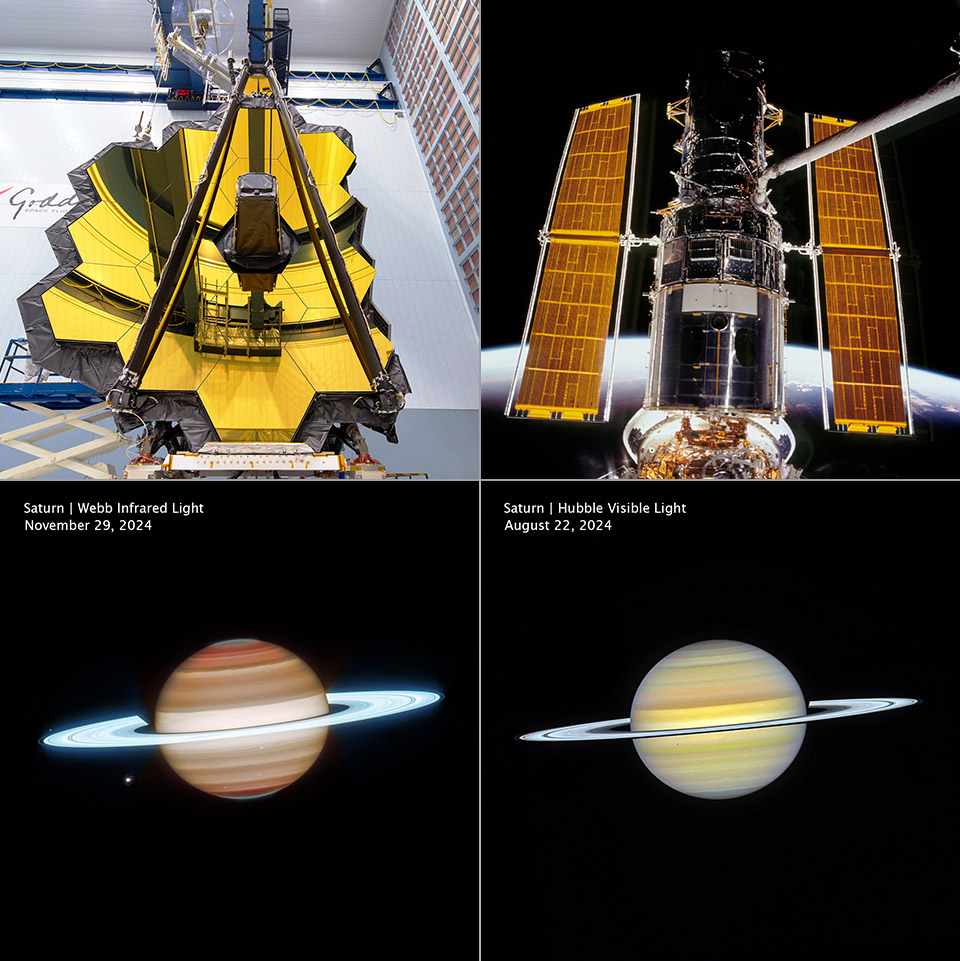
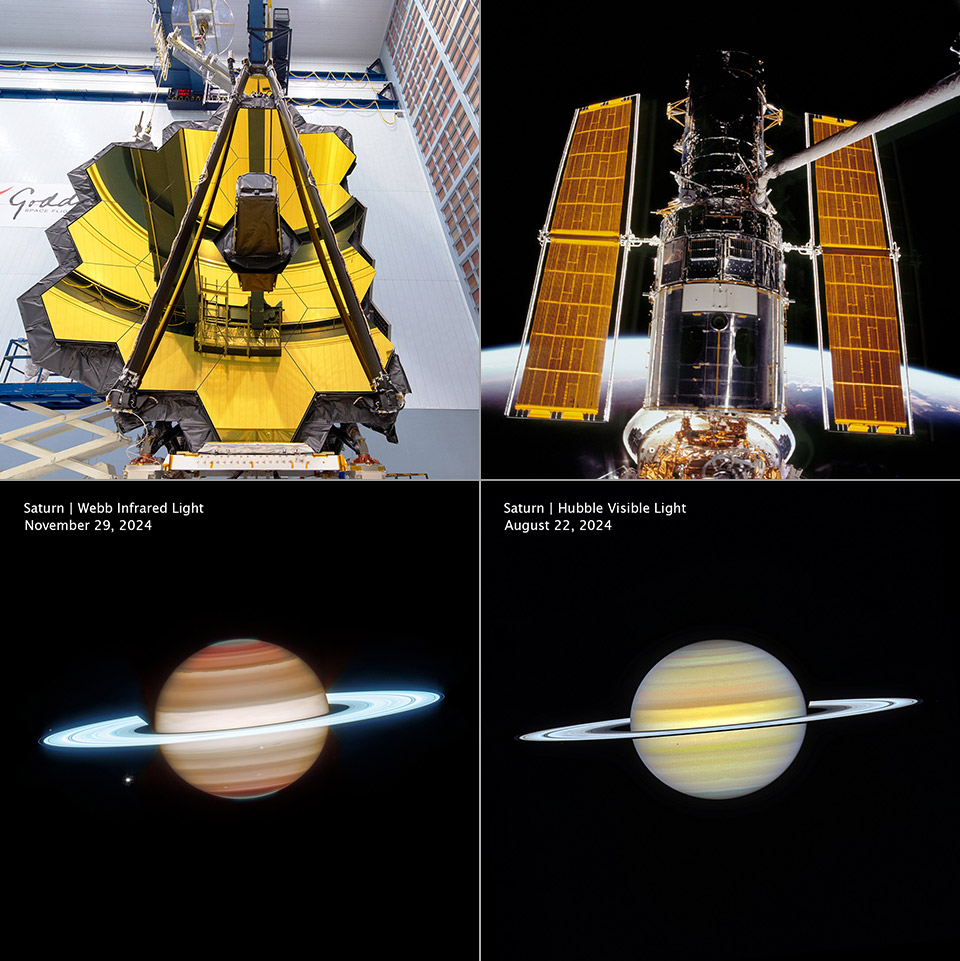
Astronomers have just released what may be the sharpest views of Saturn ever captured, courtesy of the Hubble and James Webb space telescopes working in tandem. One image was taken in visible light and is breathtaking on its own, while the other, captured in infrared, pulls back the curtain on an entirely different layer of detail across the planet’s clouds, rings, and poles.
Hubble captured its image on August 22nd during a routine weather monitoring sweep of the outer planets. Bands of clouds wrap around the globe with subtle shifts in tone where sunlight catches the upper atmosphere, and the rings cast long shadows across the planet’s face at that particular angle. Three of Saturn’s smaller moons, Janus, Mimas, and Epimetheus, sit quietly at the edges of the frame, adding a sense of scale to an already striking image.
Sale

Gskyer Telescope, 70mm Aperture 400mm AZ Mount Astronomical Refracting Telescope for Kids Beginners…
- Superior Optics: 400mm(f/5.7) focal length and 70mm aperture, fully coated optics glass lens with high transmission coatings creates stunning images…
- Magnification: Come with two replaceable eyepieces and one 3x Barlow lens.3x Barlow lens trebles the magnifying power of each eyepiece. 5×24 finder…
- Wireless Remote: This refractor telescope includes one smart phone adapter and one Wireless camera remote to explore the nature of the world easily…
The James Webb Space Telescope returned to the same spot a few months later on November 29th, this time with its near infrared camera. The rings respond brilliantly to infrared light, the water ice within them practically glowing in the exposure. The narrow outer F ring shows up with crisp definition alongside the broader B ring, which carries subtle spoke like structures that are easy to miss at first glance. The wider field of view also reveals six of Saturn’s larger moons, including Titan off to one side and Dione and Enceladus sitting remarkably close together.
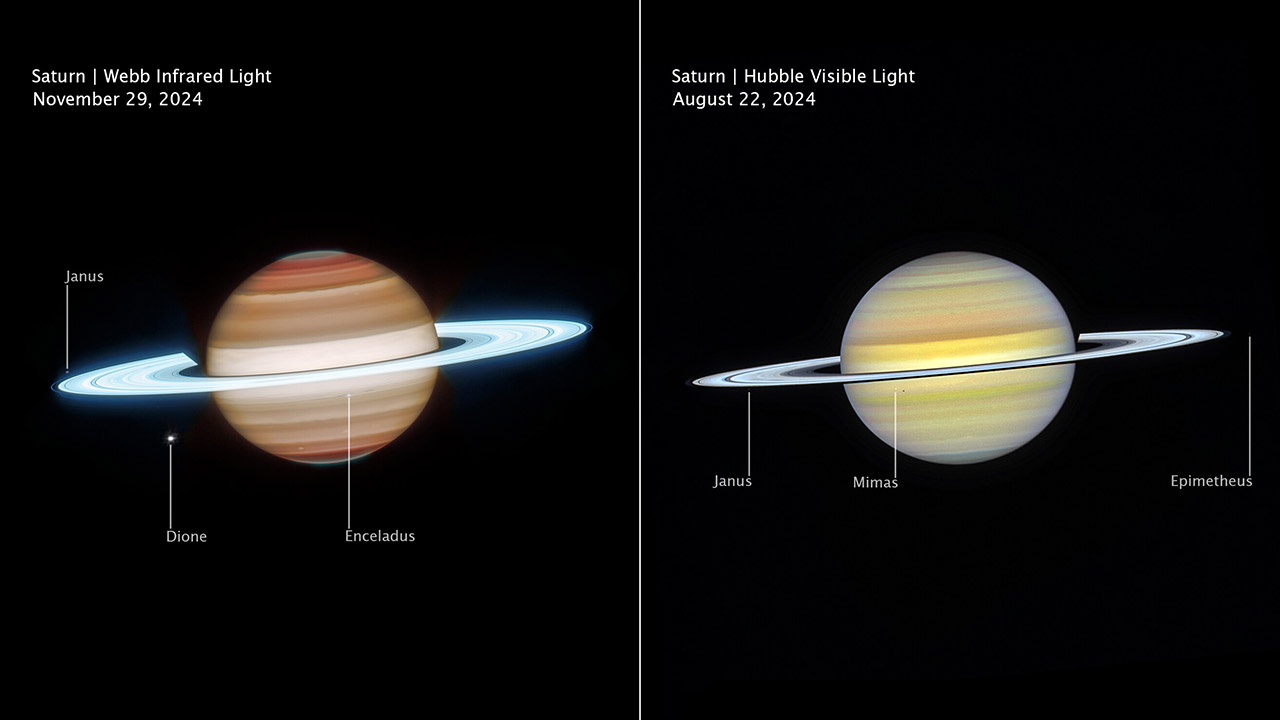
The two images were taken 14 weeks apart, during a period when Saturn was slowly approaching its 2025 equinox. The northern hemisphere is easing out of summer while the south is just beginning its transition into spring, and that gradual seasonal shift gives astronomers a rare window to track how the planet’s clouds, rings, and atmospheric features evolve over the coming decade.
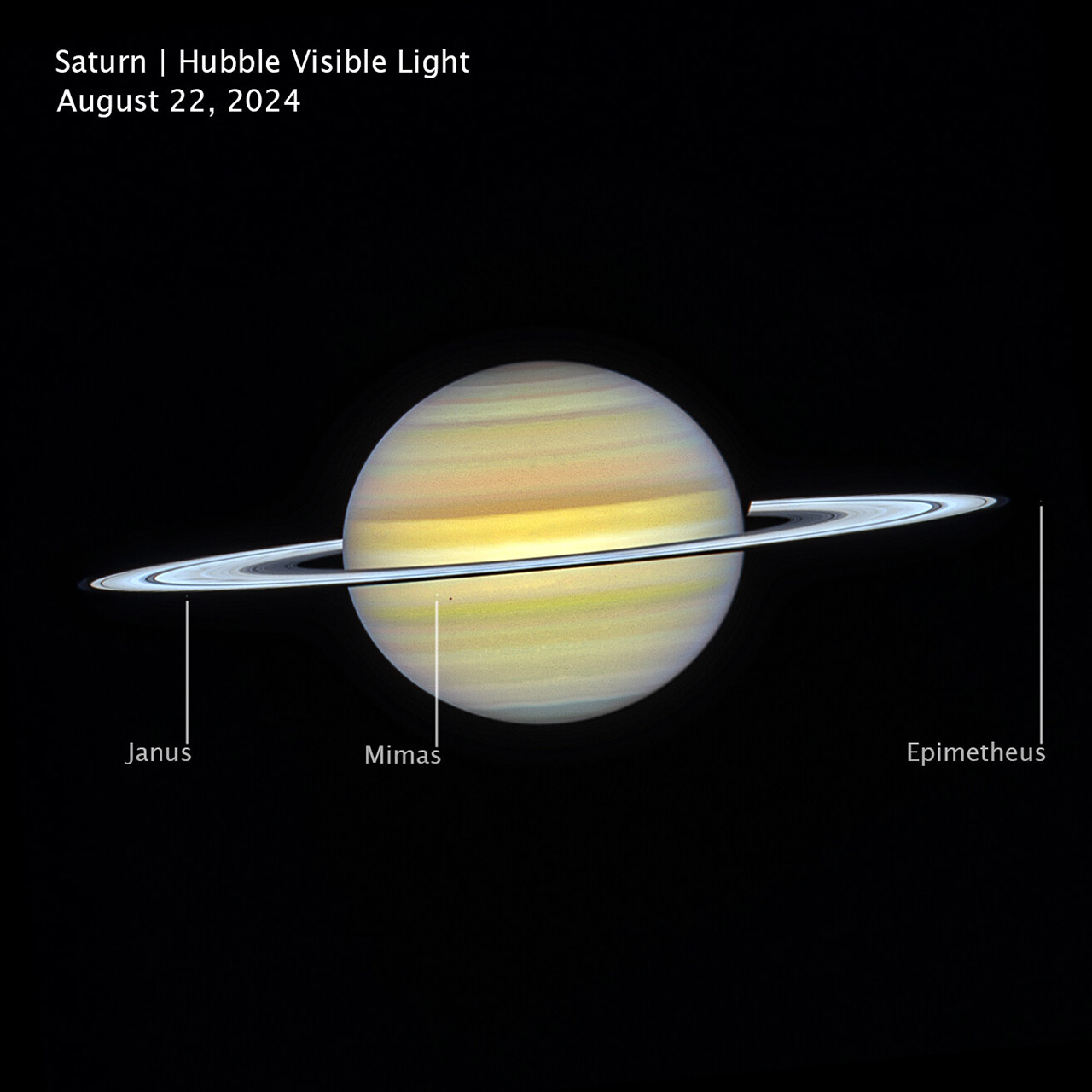
Hubble’s visible light image captures Saturn’s surface and the cloud formations that scientists have been studying for decades, but Webb’s infrared view goes considerably deeper, revealing cloud structures and atmospheric compounds at multiple levels, from the dense lower layers all the way up to the thin air at the top. Together the two images give researchers something far more powerful than either could provide alone, allowing them to study the atmosphere in layers rather than as a single flat snapshot.
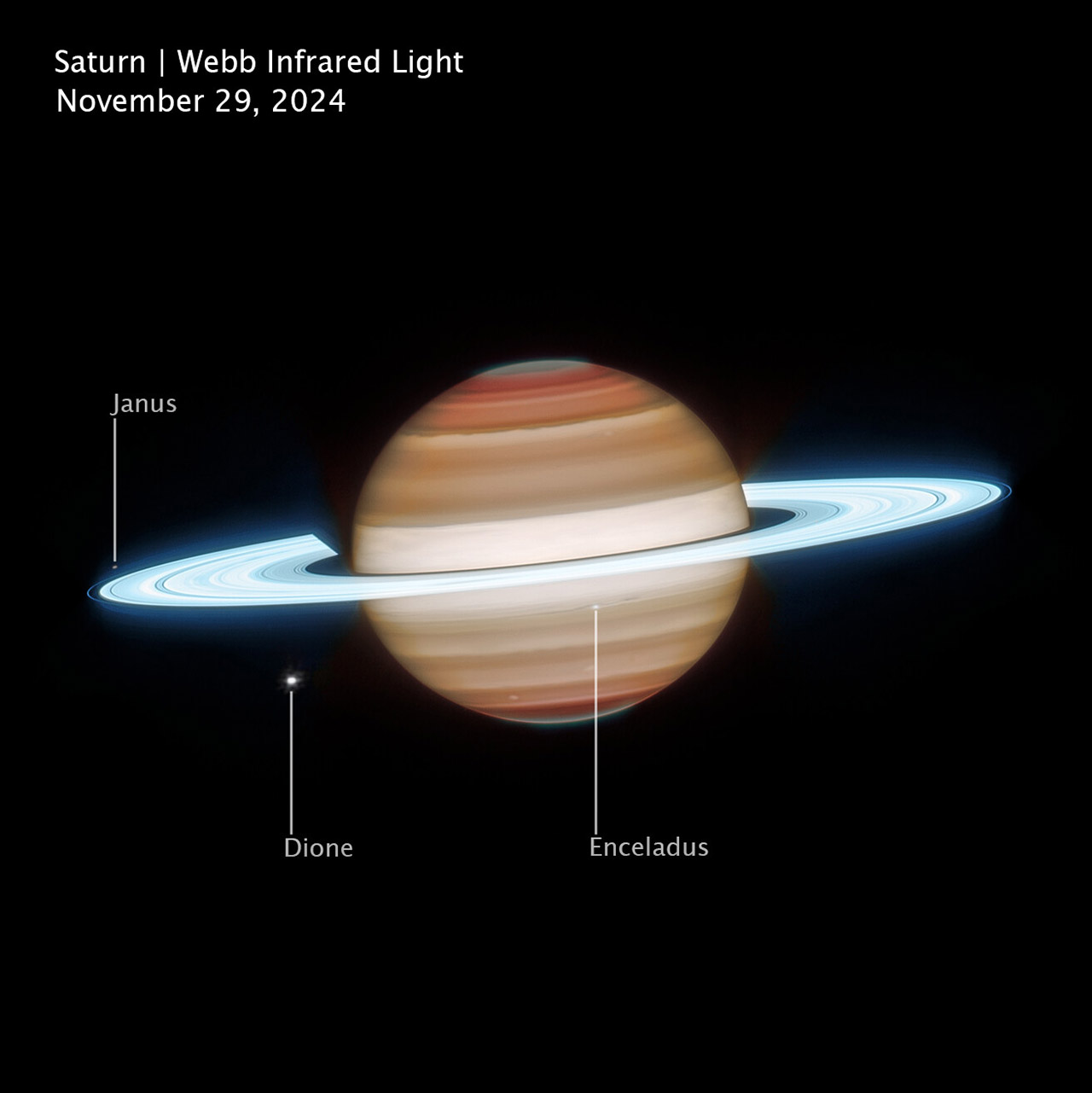
The Webb image reveals a wavy jet stream cutting across the northern mid latitudes, bent by atmospheric waves churning beneath it. Further south a handful of small storms dot the lower hemisphere, one of which appears to be the final remnant of the enormous storm system that raged for years after it first appeared in 2010. Over in the Hubble image the famous north pole hexagon is faintly visible, the six sided wind pattern that has persisted since the 1980s and shows no signs of fading yet, though it will eventually disappear as Saturn’s north pole descends into a 15 year winter by the 2040s.
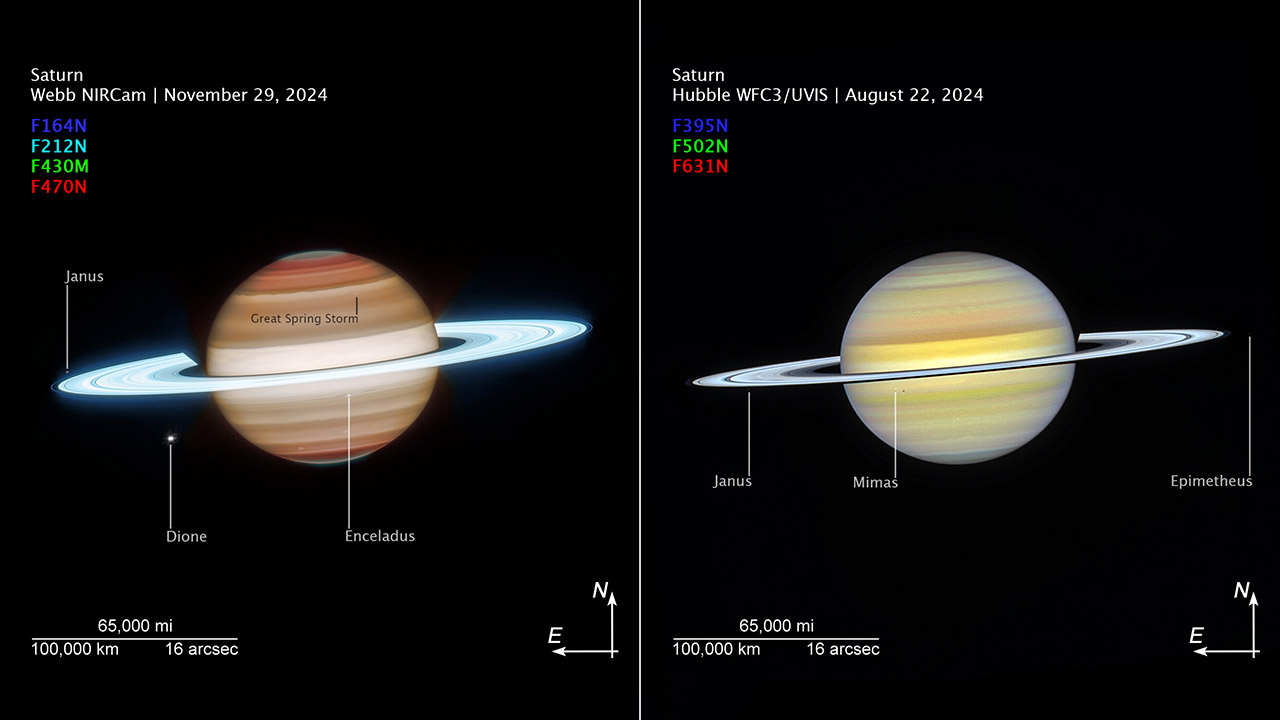
The poles in the infrared image take on a grey green tint that scientists believe could be caused by high altitude aerosols or charged particles connected to auroral activity around Saturn’s magnetic field, details that are simply invisible in visible light. The rings tell their own story across both images as well. Visible light shows their structure and the shadows they cast across the planet’s surface, while infrared highlights just how reflective the ice particles within them are, making the entire ring system pop against the darkness of space. Subtle differences between the two images also reflect the different viewing angles and wavelengths each telescope works with, adding another layer of information for researchers to work through.
[Source]
Saturn’s Rings and Storms Stand Out in Combined Webb and Hubble Telescope Views
#Saturns #Rings #Storms #Stand #Combined #Webb #Hubble #Telescope #Views