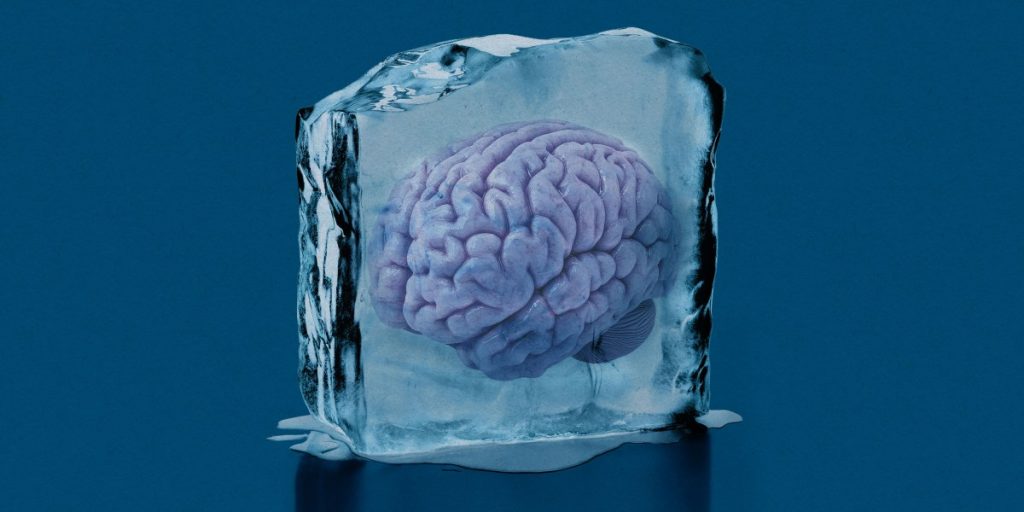
This scientist rewarmed and studied pieces of his friend’s cryopreserved brain
Fahy was involved from the time the samples were taken.
“We had Greg Fahy on the phone coordinating the whole thing, [including] where the biopsies were taken,” says Nick Llewellyn, who oversees research at Alcor. (Llewellyn was not at Alcor at the time but has discussed the procedure with his colleagues.) The biopsied samples were stored in liquid nitrogen and earmarked for Fahy. The rest of the brain was cooled and kept in a temperature-controlled storage container at Alcor.
Bouncing back
It wasn’t until years later that Fahy got around to studying those biopsies. He was interested in how the cryoprotectant—which is toxic—might have affected the brain cells. Previous research has shown that flooding tissues with cryoprotectant can distort the structure of cells, essentially squashing them.
It’s one of the many challenges facing cryobiologists interested in storing human tissues at very low temperatures. While the vitrification of eggs and embryos—which cools them to −196 °C and essentially turns them to glass—has become relatively routine (thanks in part to Fahy’s own work on mouse embryos back in the 1980s), preserving whole organs this way is much harder. It is difficult to cool bigger objects in a uniform way, and they are prone to damaging ice crystal formation, even when cryoprotectants are used, as well as cracking.
Fahy found that when he rewarmed and rehydrated Coles’s brain cells, their structure seemed to bounce back to some degree. Fahy demonstrated the effect over a Zoom call: “It looks like this,” he said with his hands as if in prayer, “and it goes back to this,” he added, connecting his forefingers and thumbs to create a triangle shape.
The structure of the tissue looks pretty intact, too, to him at least, though he admits a purist expecting a pristine structure would be disappointed. He and his colleagues have been able to see remarkable details in the cells and their component parts. “There’s nothing we don’t see,” says Fahy, who has shared his results, which have not yet been peer reviewed, at the preprint server bioRxiv. “It seems that [by taking the cryogenic approach] you can preserve everything.”
As for the cracking, “from what I was told, no cracks were observed [by the team that initially preserved the brain],” says Fahy. The team at Alcor took photographs of the brain when they took the biopsies, but the images were later lost due to a server malfunction, he says. In the more recent photos, the brain is covered in a layer of frost, which makes it impossible to see if there are any cracks, he adds. Attempts to remove the frost might damage the brain, so the team has decided to leave it alone, he says.
Back to life?
Fahy and his colleagues used chemicals to “fix” Coles’s brain samples once they had been rewarmed. That process is typically used to stop fresh tissue samples from decaying, but it also effectively kills them.
#scientist #rewarmed #studied #pieces #friends #cryopreserved #brain