Transcript: Iranian Foreign Minister Abbas Araghchi on “Face the Nation with Margaret Brennan,” March 15, 2026
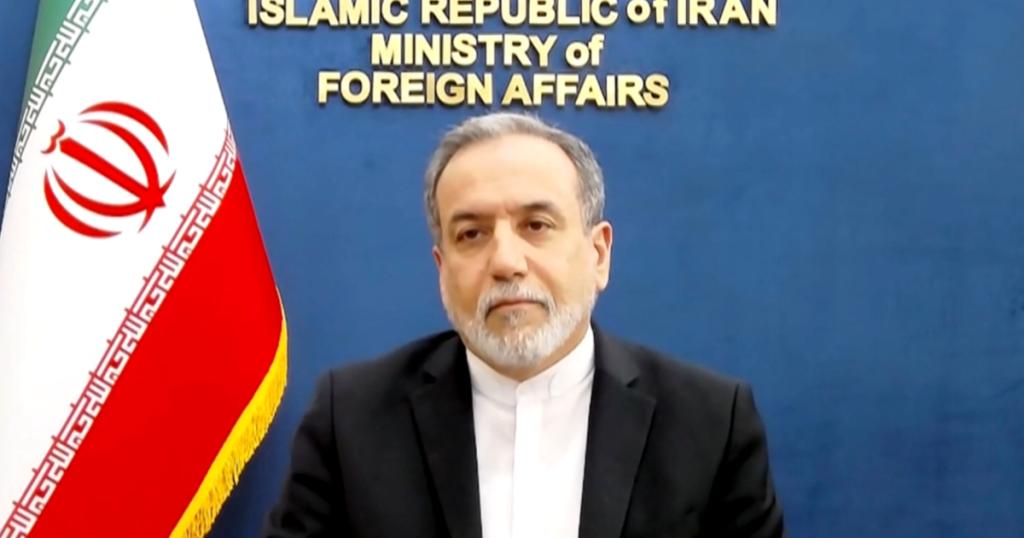
The following is the transcript of the interview with Iranian Foreign Minister Abbas Araghchi that aired on “Face the Nation with Margaret Brennan” on March 15, 2026.
MARGARET BRENNAN: Charlie D’Agata in Tel Aviv. We turn now to the Foreign Minister of Iran Abbas Araghchi. Good evening to you, sir.
FOREIGN MINISTER ABBAS ARAGHCHI: Well, good evening to you. Thank you for having me for the second time.
MARGARET BRENNAN: Yes, and they are extraordinary times. Minister, President Trump said this weekend he is not ready to make a deal with Iran because the terms aren’t good enough yet. His administration is saying this war could last another three and a half weeks or so. Has Iran asked for a cease fire?
MINISTER ARAGHCHI: No, we never asked for a cease fire, and we have never asked even for negotiation. We are ready to defend ourselves as long as it takes. And this is what we have done so far, and we continue to do that until President Trump comes to the point that this is an illegal war with no victory. And you know, there are, you know, people being killed only because President Trump wants to have fun. This is what he has said–
MARGARET BRENNAN: –have fun?
MINISTER ARAGHCHI: So, we are not- yes, this is what he said, that they are sinking, you know, ships and targeting different places because it is fun. And the Secretary of War has said that there is no- no mercy, and this is actually a war crime. Even even saying that is a war crime. So this is a war- this is a war of choice by President Trump and the United States, and we are going to continue our self defense.
MARGARET BRENNAN: Well, that may be your position, but, sir, this is a war of survival for your government. Minister, don’t you have to negotiate and reach out, either directly or through a third party?
MINISTER ARAGHCHI: No, it’s not a war of survival. We have- we are- we are, you know, stable and strong enough. We are only defending our- our people, from the you know, the- this, this act of aggression. And we don’t see any reason why we should talk with Americans, because we were talking with them when they- when they decided to attack us, and that was for the second time. There is no experience- good experience talking with Americans. We were talking. So why they decided to attack us? So what is good if we go back to talk once again?
MARGARET BRENNAN: Well, I want to come back to that in just a moment. You’re referring to the diplomacy with President Trump’s son-in-law, Jared Kushner, and his envoy, Steve Witkoff. But just to continue on this, Iran is sending its drones and its missiles into your neighboring countries, American allies throughout the Gulf. Before the war, your government traded with them. You had relations with them. If your government survives this conflict, how do you go back to doing business with countries you’re sending drones into and hitting civilian targets?
MINISTER ARAGHCHI: Well, obviously these are the countries who have given their soil to American forces to attack us. So what can we do? We just sit and watch that Americans are- American forces are attacking us from their soil and–
MARGARET BRENNAN: –But your drones are going into civilian areas and hitting plants and hotels and civilians–
MINISTER ARAGHCHI: No, no- no, no- no, no this is not the fact. We are only targeting American assets, American installations, American military bases. Everything belongs to Americans, and this is a fact that they are using their soil, you know, just- there are many, many examples. Just yesterday, they, you know, attacked our islands using HIMARS artillery rockets, which is- which are low range, you know, rockets and they use the territory of UAE to attack us. Some a week ago, three F-15 jet fighters were shot down, apparently, by a friendly fire in Kuwait. But nobody asked what they were doing in Kuwait. They were using Kuwait, and, you know, a space of a neighborly, a friendly country, to attack us. So it is obvious we cannot just, you know, remain, you know, silent on this.
MARGARET BRENNAN: Well, so many of these countries are part of CENTCOM, but- but this is the point is that it’s going to hurt your country in the long term. But when we talk about the Strait of Hormuz, which is such an important transit point for global trade, you have said it is closed to Israel and it’s closed to the United States. The Financial Times is reporting that European diplomats from France and Italy are talking to your government about trying to get safe passage for their ships. Are you open to restarting oil and gas vessels going through there?
MINISTER ARAGHCHI: Well, we are open to countries who want to talk to us about the safe passage of their vessels. It depends on our–
MARGARET BRENNAN: You are negotiating with France and Italy?
MINISTER ARAGHCHI: I cannot mention any country in particular, but we have been approached by a number of countries who wants to have a safe passage for their vessels. And this is up to our military to decide, and they have already decided to let, you know, a group of vessels belongs to different countries to pass in a safe and secure. So we provide them security to pass because we have not closed this strait. They are not coming themselves because of the insecurity which is there, because of the aggression by the U.S.
MARGARET BRENNAN: I want to ask you again about the negotiations. Iran has declared it has 440 kilos or so of nuclear material. Where is that material now? Who has custody of it?
MINISTER ARAGHCHI: Well, we have not declared. This is verified and declared by the agency–
MARGARET BRENNAN: — That’s right.–
MINISTER ARAGHCHI: — this is not a secret. This is not a secret. You know, the agency have said in his many reports the exact amount of our enriched, you know, nuclear material–
MARGARET BRENNAN: — Yes. So where is it now? Who has custody of it?
MINISTER ARAGHCHI: So, they are, there are under the rubbles. You know, the- our nuclear facilities were attacked, and everything is under the rubbles. Of course, you know there is the possibility to retrieve them, but under the supervision of the agency. If one day we come to the conclusion to do that, it would be under the supervision of the agency. But for the time being, we have no program. We have no plan to recover them from under the rubbles.
MARGARET BRENNAN: Am I understanding you here? Because I know that you said 48-hours before the U.S. strikes happened, you had personally offered to President Trump’s negotiators to take that 440-kilo amount of 60% enriched material and to dilute it. You said Iran was ready to give that material away. This was in the deal that was also presented to Vice President Vance by Oman. Today, is Iran still willing to let go of that enriched uranium?
MINISTER ARAGHCHI: Well, that was one of the elements of a deal that we were negotiating with our, you know, American interlocutors. That element dealt with the question of Iran’s 60% enriched material, and I said- I offered actually that we are ready to dilute those enriched material, or down blend them, as they say, into lower percentage. So that was a, you know, a big offer, a big concession in order to prove that Iran has never wanted nuclear weapons and would never want them–
MARGARET BRENNAN: — Are you willing to give that up now?
MINISTER ARAGHCHI: Well, there is nothing on the table right now. Everything depends on the future. If any time in the future we decide to enter into negotiation with U.S. or other interlocutors, you know, we may decide what to put on the table. For the time being, nothing is- nothing is on the table.
MARGARET BRENNAN: There are at least four Americans being held at Evin Prison that we know of, including a journalist, Reza Valizadeh and Kamran Hekmati, a 61 year old man. What is the status of those Americans? Are they safe?
MINISTER ARAGHCHI: Well, if they- if the U.S. and Israel do not attack our prisons. I guess they are safe.
MARGARET BRENNAN: Foreign Minister, we are running out of time, and I can see the internet is going in and out here. I just do want to point out you’re speaking to us via Zoom. The Iranian people don’t have open Internet access, but you do. Why?
MINISTER ARAGHCHI: Well, I’m the voice- because I’m the voice of Iranians, and I have to defend their right. So this is why I have access to internet to just, you know, have- have our voice being heard by the international community. But internet is closed because of the security reasons, because we are under the- under attack, we are under aggression, and we have to do everything to protect our people. In any country, there are, you know, urgent measures taken for this, for the sake of war.
MARGARET BRENNAN: Minister, I’m glad the uplink worked to talk to you right now. We thank you for your time this morning, Face the Nation will be back in a minute. Stay with us.
Transcript: Iranian Foreign Minister Abbas Araghchi on “Face the Nation with Margaret Brennan,” March 15, 2026
#Transcript #Iranian #Foreign #Minister #Abbas #Araghchi #Face #Nation #Margaret #Brennan #March