3 New Jersey teens took part in a weeklong experiment to curb screen time. It worked.
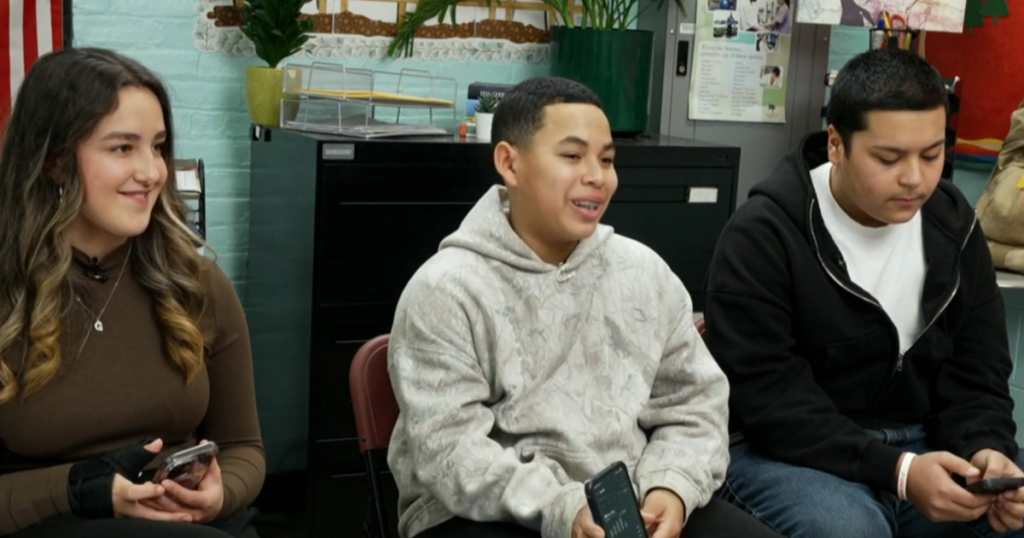
Clifton, New Jersey — At Clifton High School in Clifton, New Jersey, senior Gianna Colon is a three-sport athlete, sophomore Sebastian Fazio loves math and baseball, and sophomore Hamza Ramach is in band and is a goalie on the school hockey team.
What do they have in common? They are three productive students who also struggle with screen time.
Colon told CBS News that when she spends too much time scrolling on her phone, it makes her “feel drained.”
According to students, they can spend anywhere from four to 13 hours per day on their phones, with bedtime being the biggest downfall.
“Sometimes, when I’m going to bed, I watch for a little bit, but then I get a little addicted,” said Fazio.
Ramach admitted that he doesn’t believe it is possible for him to cut down on screen time on his own accord.
For one week, the three agreed not to take their phones to bed, and to try different tools to reduce screen time during the day.
Colon tested out Brick, a square-shaped device, external to your phone, that can be used to block specific apps. The device can be left at home. To unblock the distracting apps, the phone must be tapped against the external device.
Ramach tried ScreenZen, a free app that takes a mindful approach to limiting screen time, by asking you to wait before opening distracting apps.
Fazio was shown how to use the grayscale mode on his phone, which removes the color, turning the screen to black-and-white.
“It does not look good,” Fazio said when he saw Instagram in grayscale. “…It takes away all the joy in it.”
The teens recorded video diaries three days into the experiment,
“I’ve been doing other things like diamond painting,” Colon said in her video.
Ramach said he had “been focusing more on school work, less distractions, more sleep.”
Fazio, meanwhile, said that he had “been more energetic waking up,” and also feeling like he had “been communicating more with family and friends.”
A week in, the reviews were still glowing.
Colon said Brick “definitely” took away the temptation of using certain apps, because there was a physical barrier, so she couldn’t unlock them while she was at school.
“It was honestly pretty good,” Colon said. “It definitely helped me be more productive without my phone.”
Ramach said ScreenZen “was great.”
“It was tempting to unblock the apps, but I went through it,” Ramach said, adding that his father noticed a positive difference in his behavior.
“I wanted to go to practice in the morning,” Ramach said. “He was like, ‘In the morning, what?'”
Fazio described his experience with grayscale as “pretty good,” saying his screen use “went down a lot.”
“I was at three hours before, and I’m at 20 minutes per day,” Fazio said, adding that the difference felt “great.”
Asked what she wanted other kids to know after taking on this challenge, Colon said: “You don’t need to depend on your phone for everything. Like there’s so much more out in the world…besides just sitting on your phone for hours and scrolling through TikTok or Instagram.”
#Jersey #teens #part #weeklong #experiment #curb #screen #time #worked