Pairing industrial AI autonomy and human control
“There is a lot more refinement to be done, a lot more proof points, testing, and validation needed,” McGreevy says about the ongoing process of making AI autonomous. In the near term, McGreevy expects agentic AI to follow the path seen in other industrial technologies like SCADA systems. “The ‘S’ in SCADA means supervisory, and supervisory means there’s a human in the middle,” he says. He sees AI working mostly in that advisory mode for the foreseeable future, with full autonomy limited to narrow, highly repetitive tasks.
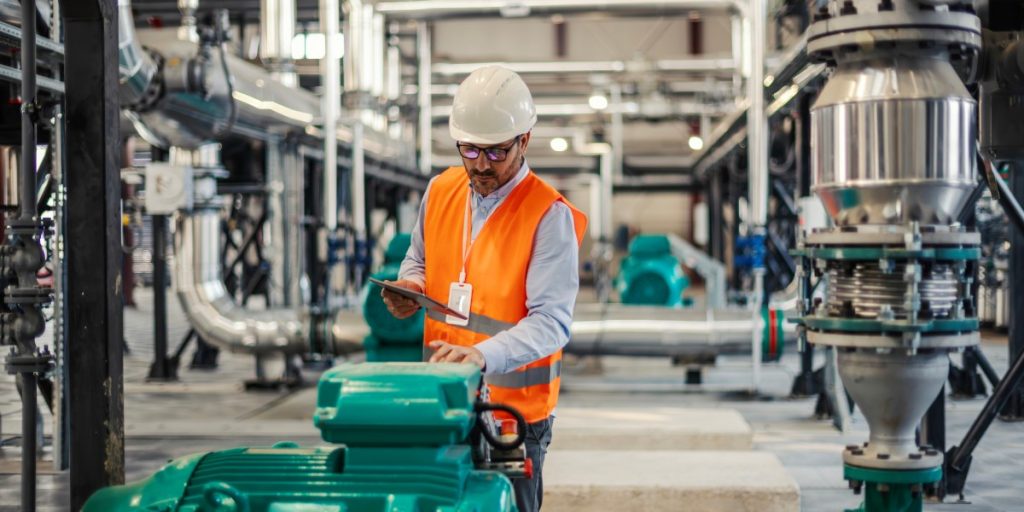
As for the role human operators play, the day-to-day is evolving. Workers who once specialized in a single process line or maintenance task can now take on multiple disciplines. They can spend less time and effort approving routine actions one by one, and more on defining acceptable operating limits. Because AI can reinforce patterns in the data it receives, catching missteps early is a core part of the job. Human knowledge and experience in interpreting what AI is seeing and doing is instrumental.
Governance on a company- and industry-wide scale, too, needs to adapt to the times. Organizations must establish clear guardrails for which decisions AI can make on its own and how its actions are monitored and audited. Still, many have yet to set up comprehensive safeguards: In a recent study from AVEVA and IMD (opens in new tab), 43% of organizations said AI has changed decision-making and accountability across ecosystem partners only slightly or not at all, while just 23% reported a significant or fundamental change. (Only 27% reported sharing data substantially or extensively with partners.)
In the meantime, regulators are starting to define some of the rules. The EU AI Act classifies certain AI safety components used in critical infrastructure as high-risk and imposes requirements for human oversight. Companies are setting up their own structures as well; AVEVA, for one, has a responsible AI governance board and a published set of principles for how AI is developed and deployed.
Inside the semi-autonomous systems already running, that oversight looks different from one deployment to another. In some cases, an operator approves every action; in others, AI acts on its own while people oversee and define the boundaries it can operate within. McGreevy cites several examples of what machine autonomy and human-plus-machine collaboration looks like among AVEVA customers:
- At Saudi Aramco’s Yanbu refinery, optimization algorithms adjust production in a closed loop, with operators overseeing as needed. At its Ras Tanura refinery, the algorithms recommend changes and operators decide whether to implement them.
- Nestlé uses AI optimization at Nesquik plants to tune the industrial dryers used to produce powdered beverage ingredients. In a landmark test, this tuning reduced energy use by 16%, while improving quality and yield.
- At Thailand’s SCG Chemicals, an AI-supported digital twin spanning engineering, operations, and maintenance monitors asset health and flags potential failures. The company reports 99% plant reliability and a ninefold return on investment within six months.
- The National Laboratory of the Rockies in the U.S. has built a generative AI model for grid control rooms to provide oversight at scale. The model supports operators with renewable energy forecasting and estimates of grid conditions.
The same synchronization that was once missing from individual plants’ technology systems has also been lacking on a larger scale. “Manufacturing and critical infrastructure have operated as siloed systems for the last 50 years,” says McGreevy. But certain emerging technologies, he suggests, are creating opportunities for more holistic coordination.
On an enterprise level, this might involve the integration of physical AI: systems that pair robotics and sensing technologies with AI-powered decision-making. Drones that fly over pipelines and power lines, for instance, can feed visual inspection data to algorithms that spot gas leaks and other hazards. Not only does this create a more accurate and interconnected flow of information, but it spares humans from needing to physically enter potentially dangerous environments. “The robotics-meets-software convergence will mean fewer incidents, fewer outages, and a more sustainable way of operating,” McGreevy predicts.
A bigger-picture version extends beyond any one plant or process to entire industrial networks, something McGreevy dubs the “integrated value chain.” “Living digital twins make digital manifestations of the entire value chain possible,” he says. “This allows companies to react quickly to supply chain changes, demand changes, tariffs, and material availability.”
Amid today’s realities of turbulent geopolitics and shifting regulatory demands, such resilience will be “an absolute necessity,” adds McGreevy. “Without it, it will be very hard to run an effective business.”
#Pairing #industrial #autonomy #humancontrol