James Webb Space Telescope Uncovers Overlapping Jets and a Golden Cavity in NGC 7129
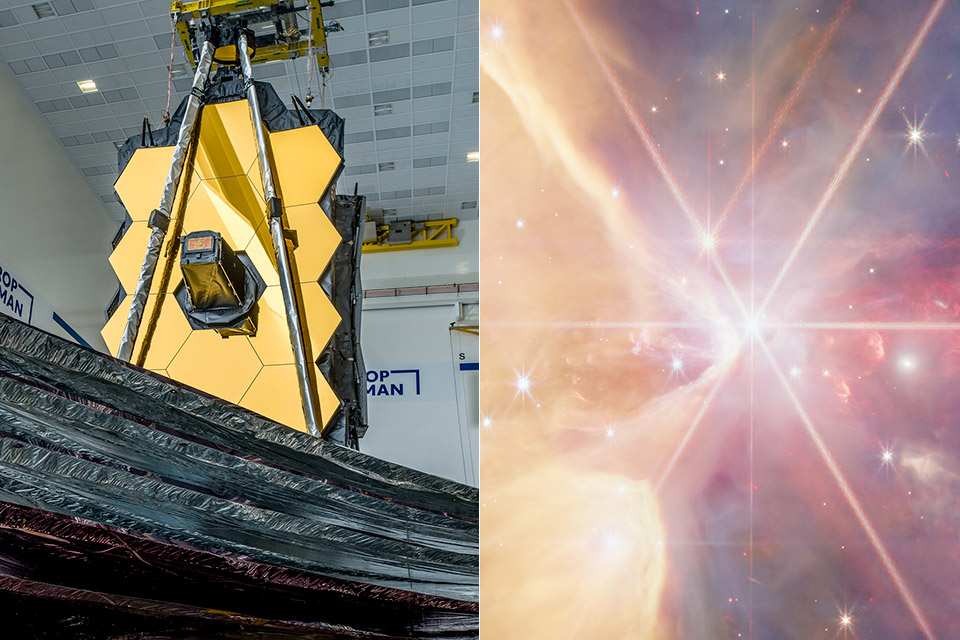
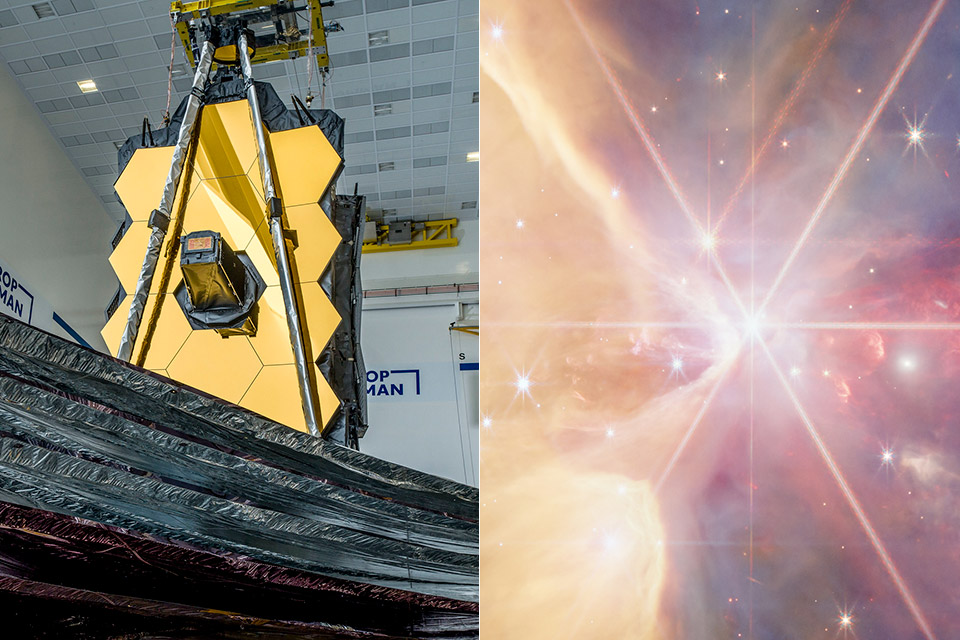
Photo credit: NASA/Chris Gunn
NASA’s James Webb Space Telescope turned its near-infrared camera toward a dusty patch of the constellation Cepheus and returned an image of NGC 7129 that lays out several stages of star formation across a single frame. Roughly 3,300 light-years from Earth, the region spans about 5.7 light-years and holds both young stars that have already begun to clear space around themselves and still-forming objects buried deeper in cold gas. Observations collected on December 17, 2025, and released on October 6, 2026, show how those objects push and heat the material that surrounds them.
At the center is a young LkHα 234, a pre-main-sequence star with an estimated mass of five to eight times that of the Sun. Its light is diffracted by the telescope’s optics, producing a noticeable set of diffraction spikes near the top of the image. When this star was smaller, its winds carved out a zone of about 3.5 light years across on the left side of the image. The gas inside that gap is heated to the point where it dissociates from molecules to individual atoms, which is why it appears golden in this image; other pre-main-sequence stars are also present in the burning cavity. Their jets compress gas into curves, which are the light arcs that line the edge of the enormous golden hollow, since those curves are shock-waves of gas compressed by the jets.

LEGO Icons Hubble Space Telescope 11382 | Building Sets for Adults, Ages 18+, Space Model Decor, Home…
- EXPLORE THE HUBBLE SPACE TELESCOPE – Celebrate one of humanity’s greatest scientific feats while enjoying a relaxing building experience with the…
- REPLICA SPACE MODEL – Recreate the legendary space-based telescope with posable solar arrays and antennas, an opening aperture door and a detailed…
- AUTHENTIC DETAILS – Remove the exterior panels to reveal a detailed instrument bay, which features gyroscopes alongside primary and secondary…
On the right side of LkHα 234, the situation is quite different. Molecular hydrogen appears as clumps of red gas. Younger protostars are accumulating mass and emitting material in all directions. This substance interacts with the surrounding gas, causing thin layers to heat up and turn red. Several of these outflows can be observed crossing our line of sight, making their courses appear to be intertwined, yet they are all on separate routes. As you get further away from the locations where new stars are produced, the gas cools, becomes denser, and appears gray. It remains thick enough to constitute the beginning material for new stars. A blue area in the upper left corner holds another young star, and its surrounding disk casts a shadow on the nebula.
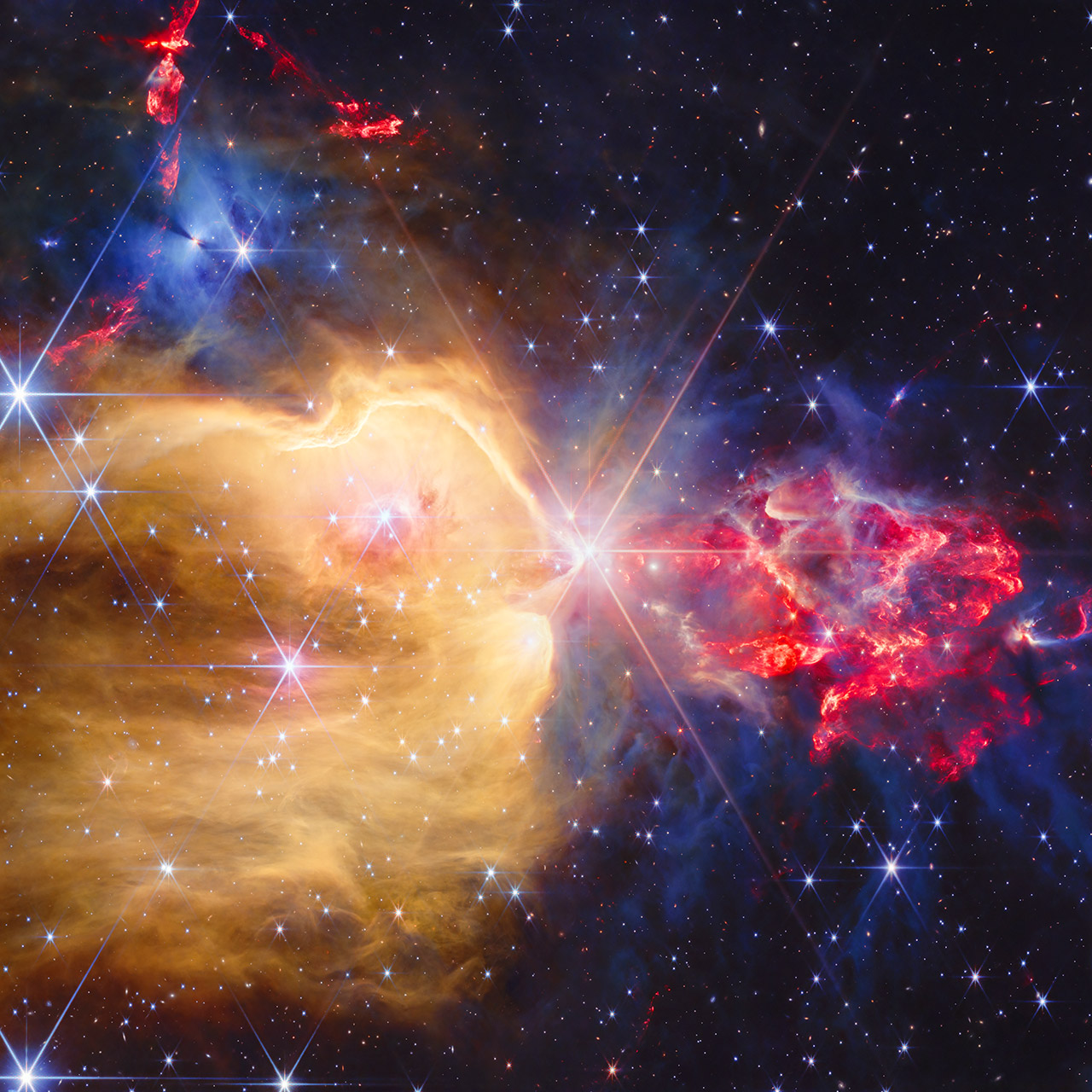
The Spitzer Space Telescope had previously imaged this location, but it could only detect large blocks of color, not fine details, whereas the Webb telescope’s improved mirror and IR capacity allows us to see many individual filaments and bow shock wavesy things. In addition, we can discern some distant background galaxies behind the nebula. The colors were allocated based on the filters employed, so the gold bits represent the hotter atomic hydrogen and the red bits represent the protostars upsetting the cooler molecular hydrogen.
Scientists will use this information to trace the growth of the nascent stars as they gradually erode away the remaining molecular cloud, compressing some gas and cooling others. It all happens over millions of years, and some of the leftover material will eventually become new stars. As you scan across this image, you will notice that the larger objects in the frame have already completed the most of their mass collection and are now shrinking under gravity, causing their interior temperatures to rise. LkHα 234 will eventually fuse hydrogen in its core, a significant milestone for any star. Meanwhile, the protostars on the right are still in their early phases, pulling in material and releasing jets into space. So we have a snapshot in time of stars that have already completed their primary growth phase and young stars that are just getting started, as it is an astounding image that demonstrates the age and youth of the stars in this particular area.
James Webb Space Telescope Uncovers Overlapping Jets and a Golden Cavity in NGC 7129
#James #Webb #Space #Telescope #Uncovers #Overlapping #Jets #Golden #Cavity #NGC