First Look at DirectHop, the Tiny One Gram Robot Precisely Hops Over Stairs with Motor Control
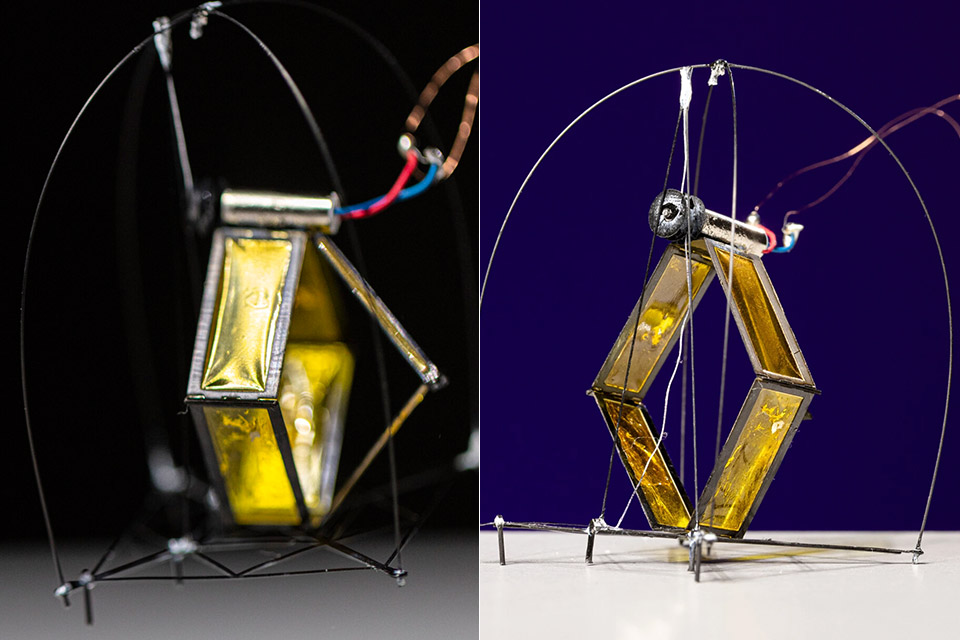
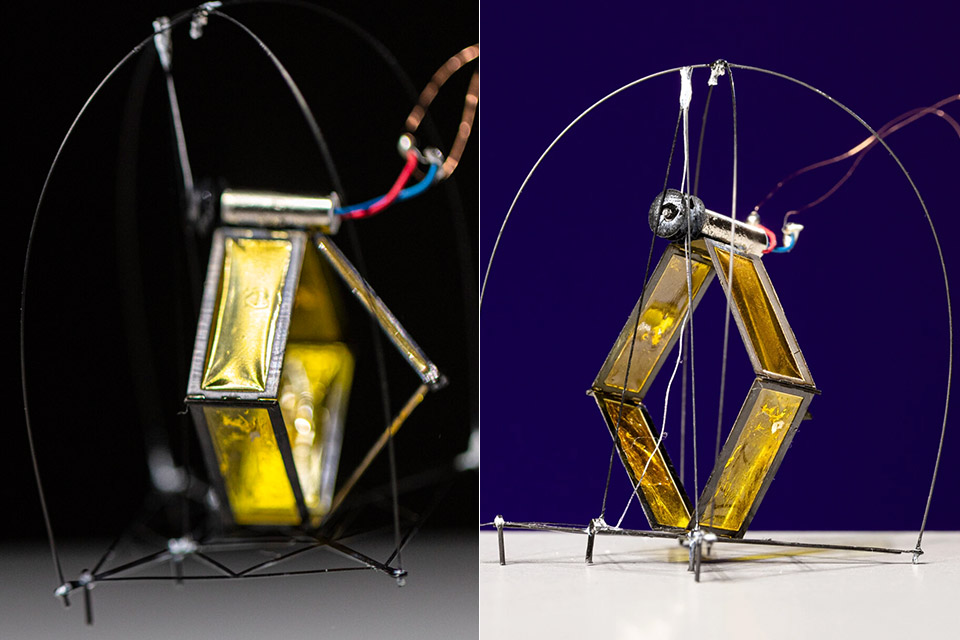
Photo credit: Mark Stone/University of Washington
University of Washington engineers have built DirectHop, a one gram robot small enough to sit in a palm that clears a standard stair step while setting its jump height to single centimeter accuracy. The prototype performs multiple hops in sequence and rights itself after most landings, steps toward an autonomous version that could move through varied spaces.
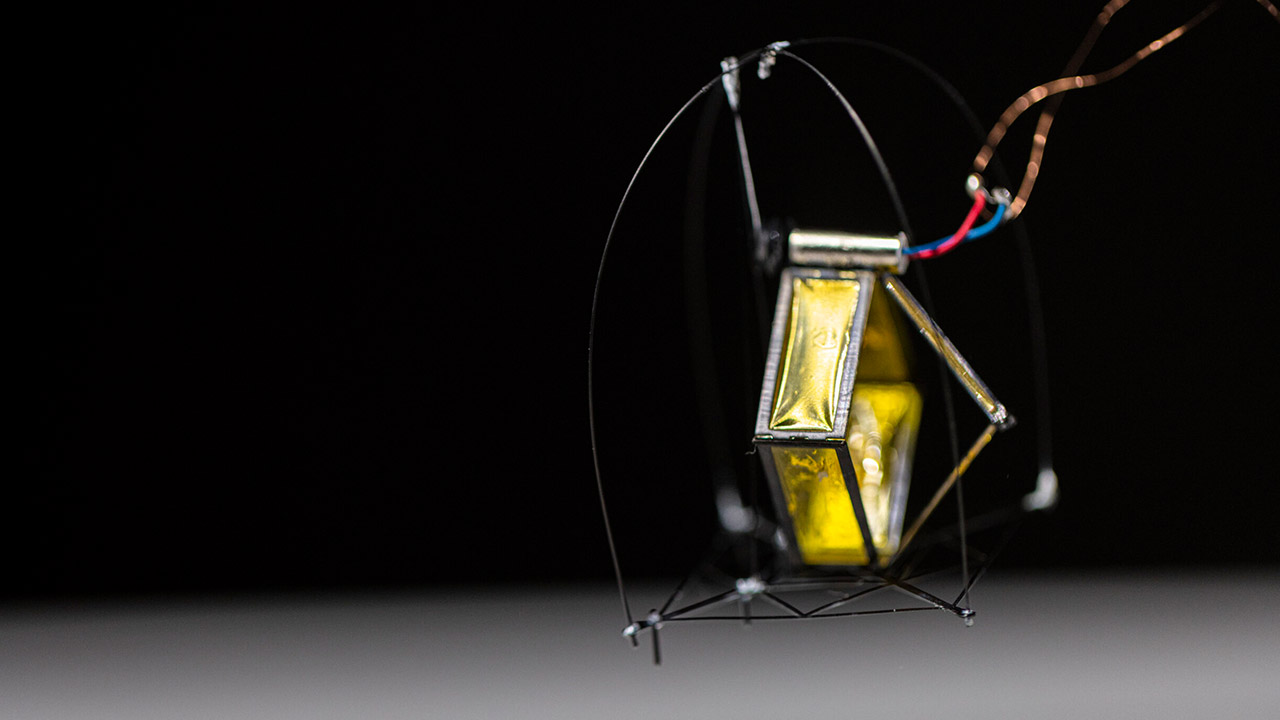
Unlike spring loaded hoppers, which simply explode into action and release a predetermined amount of energy all at once, DirectHop employs a tiny coreless electric motor to power each jump separately. This engine is attached to a small tower by a length of polyethylene fishing line, and when a charge is applied, it simply starts spinning a pulley and winding the line. As it does so, it pulls itself upward, elevating the remainder of the body into the air and giving the robot a stable, controlled motion. Three folding legs constructed of laser cut carbon fiber composites are all connected to keep the robot’s motion straight and in line, which is necessary because the robot is using a pulley system. When operators need to change the height, they just adjust the current, and the robot responds smoothly, as there is a fairly linear relationship between power and ascent. In experiments, they were able to get the center of mass up to just over 28cm, as well as some very little jumps of only 5mm for when you need to be really precise while landing. With a bit of a ramp under the foot, they were able to easily clear a 17cm stair step.

ELEGOO UNO R3 Smart Robot Car Kit V4 with Camera, Compatible with Arduino
- BUILD, CODE & DRIVE YOUR OWN ROBOT CAR: Turn coding, electronics and engineering into a working programmable robot car you can assemble, program and…
- EXPLORE FPV, LINE TRACKING & OBSTACLE AVOIDANCE: Control the robot with the ELEGOO app or IR remote, view live FPV video through the onboard camera…
- BEGINNER-FRIENDLY BUILD WITH GUIDED WIRING: Keyed XH2.54 connectors help reduce wiring mistakes, while the illustrated tutorial and example programs…
The DirectHop also has a small cage made of thin, flexible carbon fiber rods that bend round in the style of a box turtle shell, which is quite useful. It protects the body and makes recovery easier when the robot crashes back down. Even after a bad landing, the motor retracts to shift the center of gravity and the robot rolls itself back onto its feet, which is impressive enough, but they discovered that they could do this about 90% of the time in a flat space, usually in just a few seconds, and then it’s on to the next hop. The team was able to tie together a complete sequence of up to four jumps in the lab.
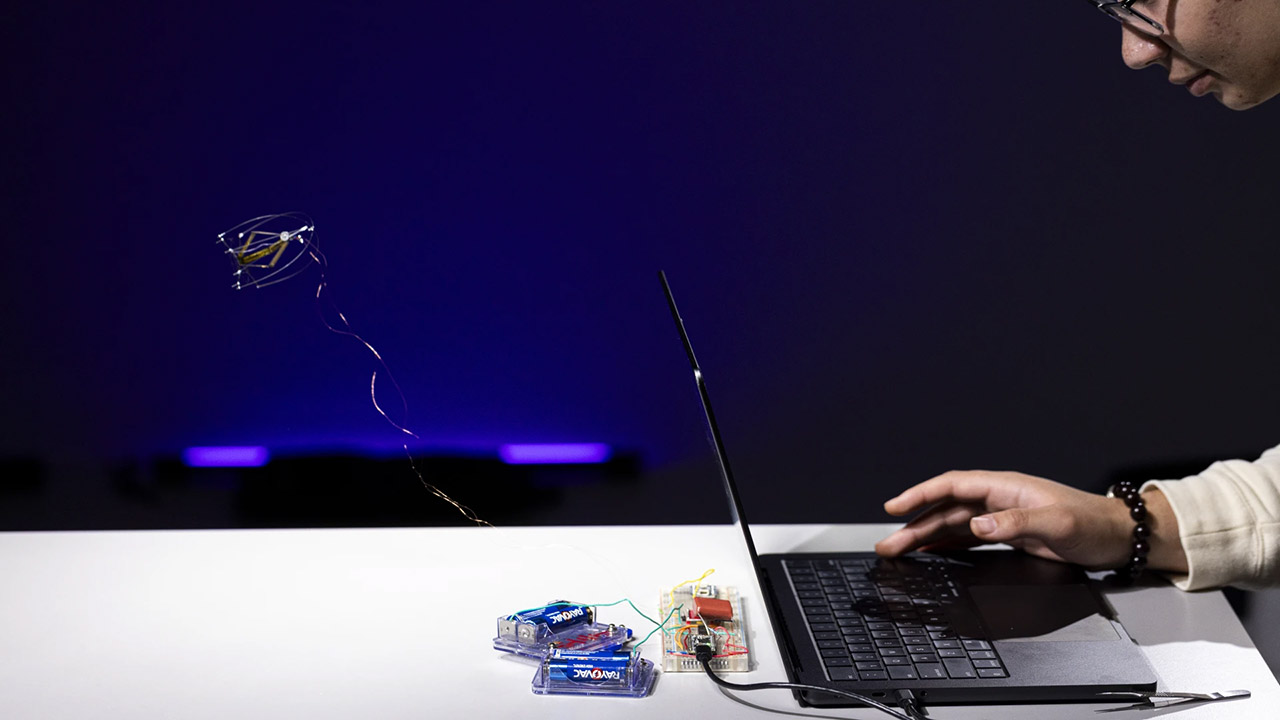
The current prototypes do have a limitation in that they still require power from a cable and instructions from a nearby laptop. However, the crew is working on it and is currently installing solar cells and a battery. They’re also aiming to include retractable feet to allow humans to set the launch angle, a vibration motor to spin the robot around so it can get itself into position, and a camera with onboard electronics to assist with navigation. One of the primary goals is to enable these robots to walk stairs on their own, which would be a game changer. The concept is that the camera would measure the size of the step, the processor would compute how high the robot should jump, and the robot would simply maneuver itself into place, jump, right itself, and continue from there.
At an estimated cost of roughly ten dollars per robot, it’s easy to see why having a group of them performing certain jobs would be very enticing. For example, you could use them to monitor a farm and track how much water and fertilizer are being used, send them out to check for leaks at an oil refinery, or simply send them off into the unknown, with the idea that you could lose a few units without interrupting the overall task. One of the best aspects of this design is that it requires significantly less energy than flying, allowing you to keep the robots running for extended periods of time on a single charge.
Sawyer Fuller, associate professor of mechanical engineering and senior author, described varying jump length, self righting, and reloading for multiple hops as the three hardest challenges for such robots. DirectHop meets all three with its direct drive approach. Lead author Hanquan Wang and co author Yash Talwekar developed the system in Fuller’s lab, with undergraduate research assistant Keo Hice running some control tests. The work, funded by the National Science Foundation, will be presented at the International Conference on Intelligent Robots and Systems.
[Source]
First Look at DirectHop, the Tiny One Gram Robot Precisely Hops Over Stairs with Motor Control
#DirectHop #Tiny #Gram #Robot #Precisely #Hops #Stairs #Motor #Control