Billet Labs Built a Fanless Gaming PC Until One Fan Made It Work


Felix at Billet Labs set out to park a real gaming PC in a living room and leave the fans off. A Ryzen 9 9800X3D and an RTX 5080 share a Gigabyte AORUS Pro B850 board, fed by a 600 watt Flex ATX supply, and the pair can pull well past 500 watts once a demanding game settles in. Air coolers handle that load by moving a lot of air. Moving a lot of air makes noise. An earlier attempt had hung the same idea on a cast iron radiator and ended near 100 kilograms, so this version started over on a hand-worked aluminum block that brings the finished machine down to about 15.7 kilograms once the loop holds roughly two liters of water.
The enormous black block on the floor is the case’s base, and 6 mm of thermal paste rests underneath the motherboard, while a big ol’ glob of paste is put under the power supply, allowing heat to be poured directly into the metal. Three radiators sit on top of the motherboard on brackets he built himself, with the paint stripped and the metal polished nicely: a large 200 x 400 mm unit at the bottom, followed by two smaller 140 and 120 class radiators laid flat so warm air can rise naturally through the fins. He closed the loop by soldering old copper piping from the home to brass fittings. A separate length of pipe capped at one end serves as a reservoir and feeds the pump. The pressure and temperature gauges are right up front. Motherboard fans are actually disabled in the bios, therefore they do not turn on. The thermal paste on the supply base is only there to keep the fan from spinning up (which it probably shouldn’t anyhow).
Sale

msi Cyborg 17 17.3″ FHD 144Hz Gaming Laptop: Intel Core 7-240H, NVIDIA Geforce RTX 5060, 16GB DDR5, 1TB…
- Thin & Light 17.3” Gaming Powerhouse: Experience big-screen immersion in a surprisingly portable design—just 0.83 in thin and 5.5 lbs—making it…
- Powered by Intel Core 7-240H for Smooth, Responsive Play: The latest Intel Core 7-240H delivers fast hybrid-architecture performance so games load…
- RTX 5060 Graphics for Next-Gen Gameplay & AI-Boosted Performance: Unlock advanced gaming with NVIDIA GeForce RTX 5060, featuring real-time ray…
The first few runs were relatively smooth, but then things became a little wacky. Even when idle, the water in the loop was exactly 28 degrees Celsius. A simple game barely put a dent in it. Cinebench, on the other hand, raised the temperature of the water to around 39.5 degrees Celsius, with processor cores reaching the low 90s. Halo remained playable, however. Cyberpunk 2077, on the other hand, raised the water temperature to 55.5 degrees, and by the end, the processor was approaching 95 degrees as the power draw dropped from 110 to 100 watts. A combined stress test eventually drove the water up to 56 to 60 degrees, just shy of the pump’s capacity.
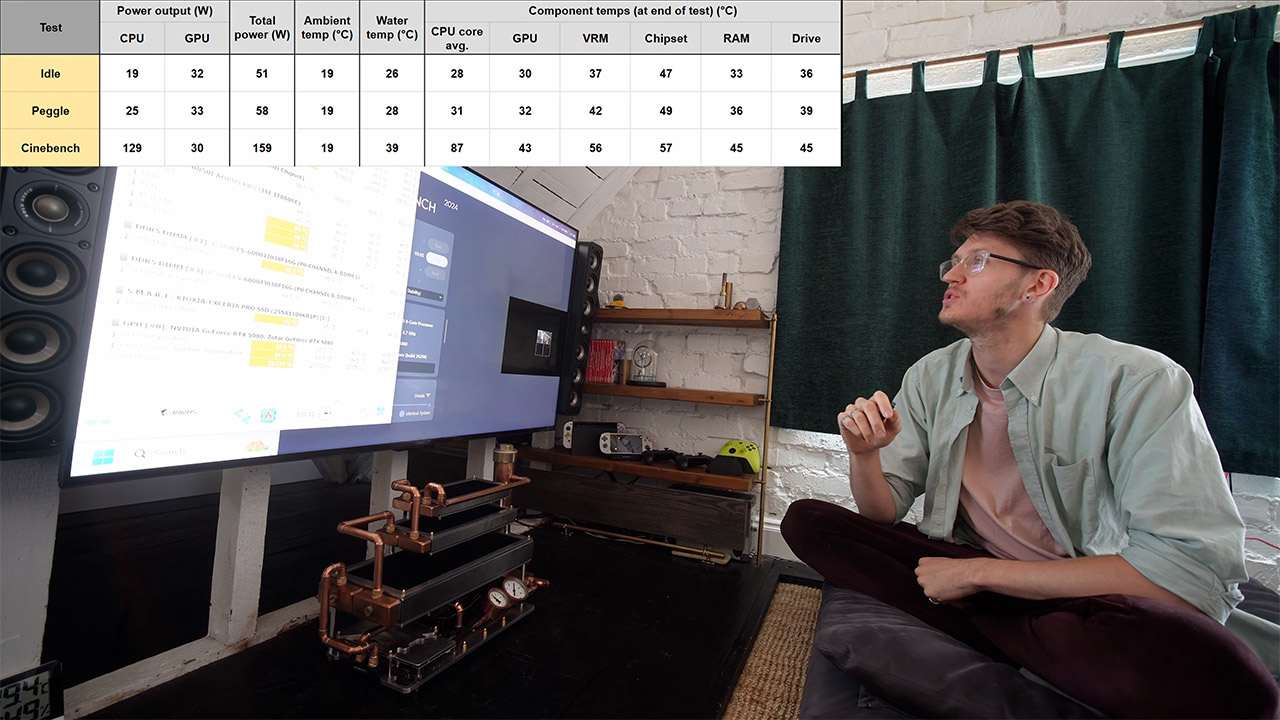
As the water heated up further, he began to notice some cavitation. The small radiators were having problems allowing air to rise beyond the dense fins, so heat was simply creeping past them rather than through. The flow order was also contributing to the problem, because the warmest water was not being directed to the top radiator first. The pressure gage was loud enough to be heard across the room, and he had nearly punctured a radiator with a screw while assembling the entire thing. That is a very good technique to melt copper pipe, though; simply pass a long, hot torch over it, and the copper absorbs all of the heat.
One 120mm Noctua fan, a small black one that blends well with the metal background, sits neatly between the two smaller radiators and draws air through the fins to provide airflow that would ordinarily be insufficient to clear them. The gage is removed, and with it, the ticking sounds. The idle water temperature drops to 22 degrees. When you run cinebench, the coolant temperature maintains at 25 degrees, the cores are in the upper 70s with a brief peak of 82, and the processor is still only drawing 129 watts without needing to be cooled.
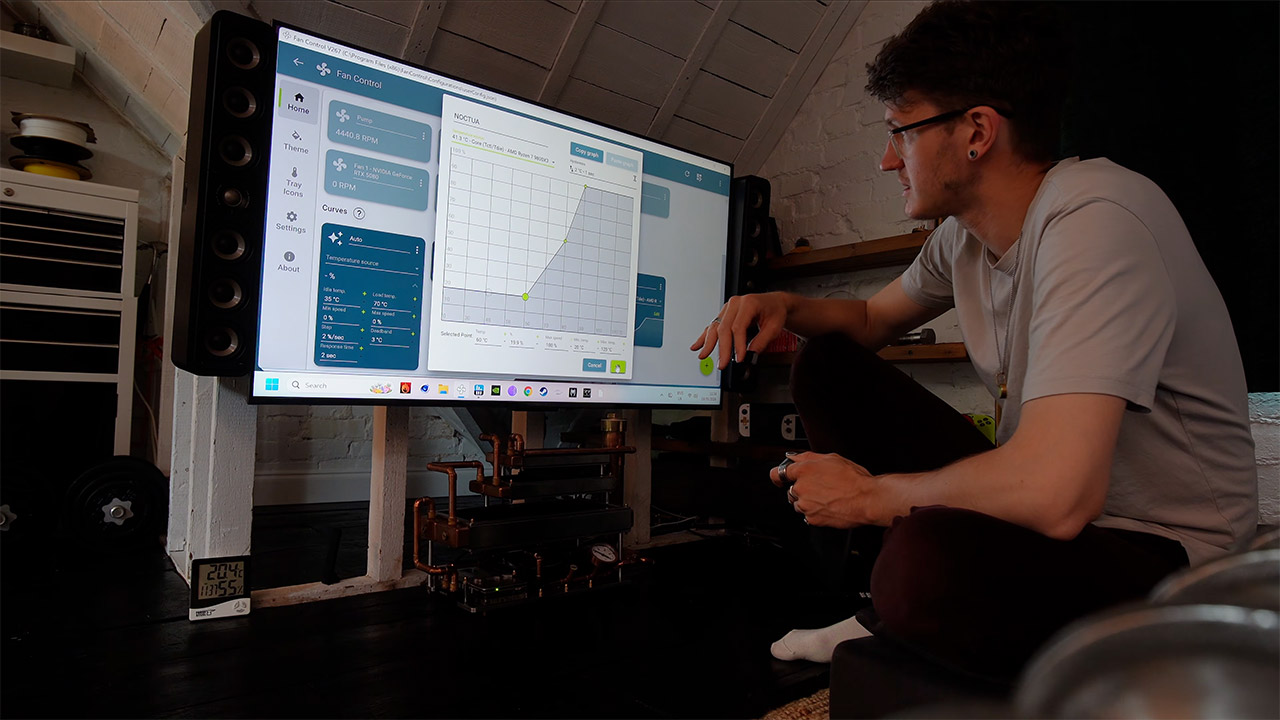
A full stress test that had been approaching 60 degrees finally settles at around 40, a full 20 degrees cooler, while the graphics card max out at 61. In ordinary games, the fan runs at a low speed and is almost inaudible, since it is quieter than the old gage even when it spins up slightly. The aluminum block already effectively cools the board and card, so all that was required was a single fan between the smaller radiators to complete the loop.
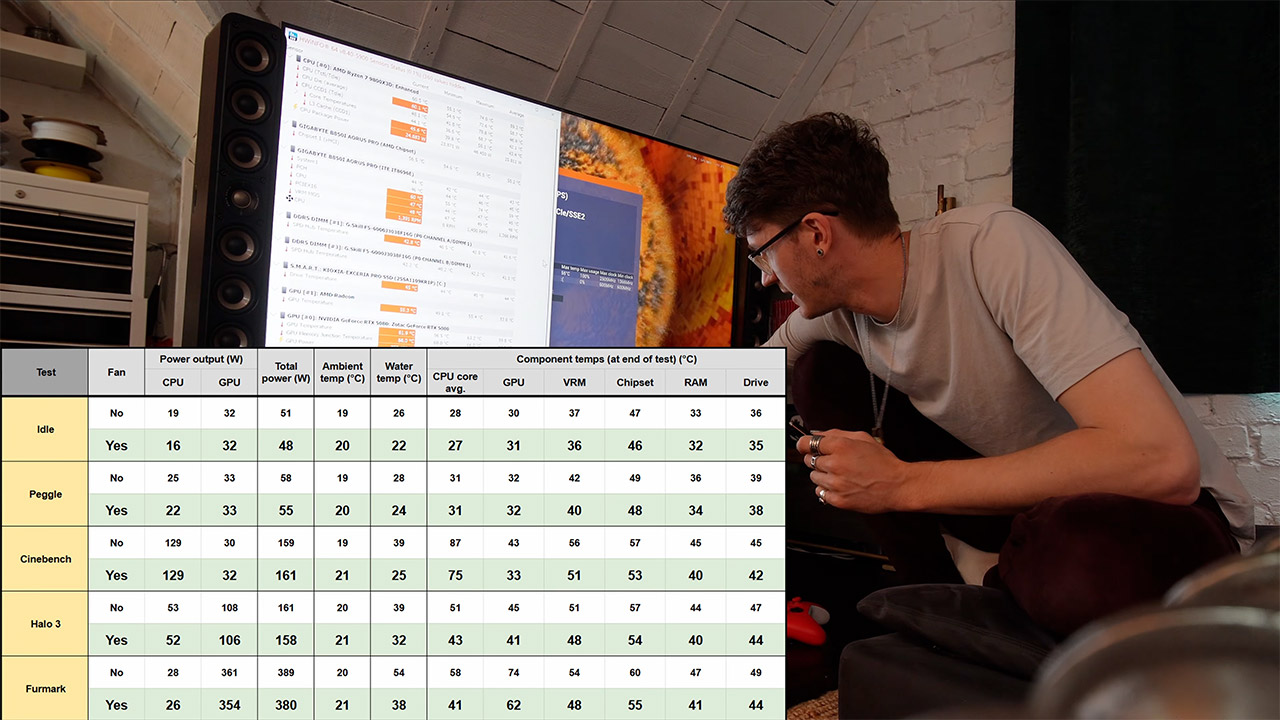
You can get by with a completely silent loop that can idle and handle some light gaming, but if you try to run a 9800X3D and a 5080 through a long gaming session, the water temperature will start to rise into the 50s and the processor will begin to fail. One quiet fan, directed at the radiators that were seriously impeding airflow, transformed the entire copper and aluminum configuration into a living room PC that looks good on a shelf and can even finish a session without crashing.
[Source]
Billet Labs Built a Fanless Gaming PC Until One Fan Made It Work
#Billet #Labs #Built #Fanless #Gaming #Fan #Work