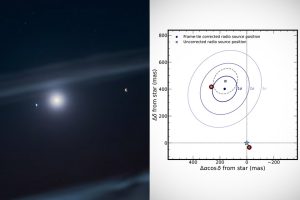
MeerKAT Picks Up the First Radio Signal Ever Heard From Beta Pictoris b
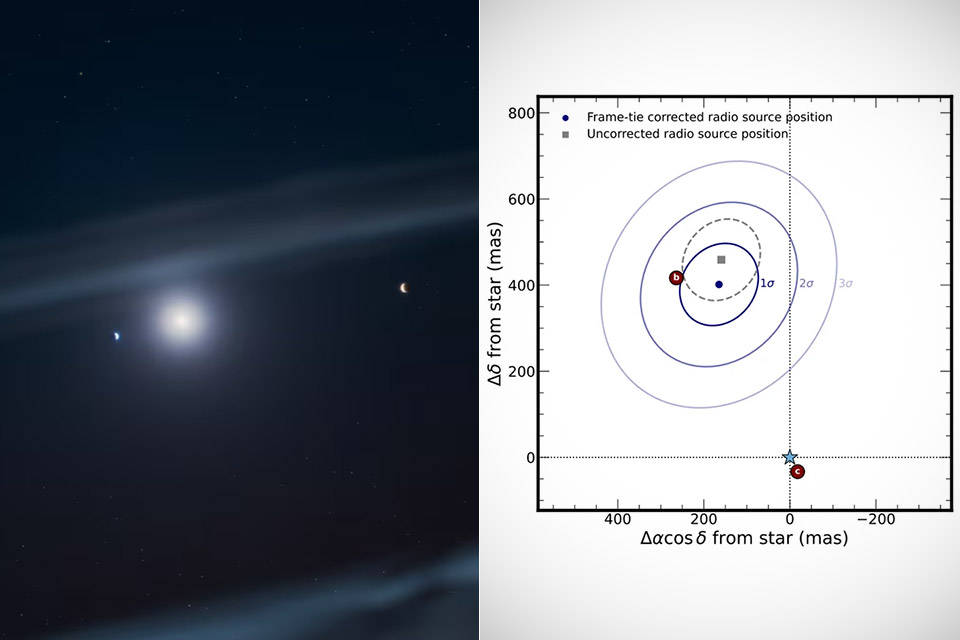
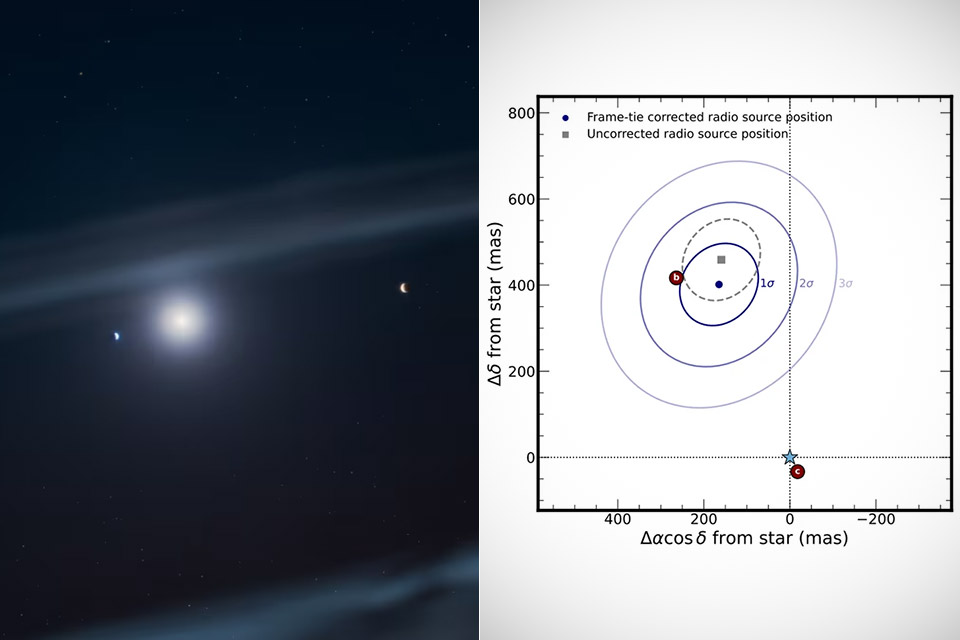
Astronomers working with South Africa’s MeerKAT array have recorded radio waves coming from Beta Pictoris b, a gas giant about 63 light-years away, and pinned those waves to the planet rather than the star it orbits. Kevin Ortiz Ceballos, a doctoral researcher at Harvard & Smithsonian, found the signal while sorting through survey data. He walked into the office of his adviser, Harvard astronomer Edo Berger, and said he did not think Berger was going to believe it.
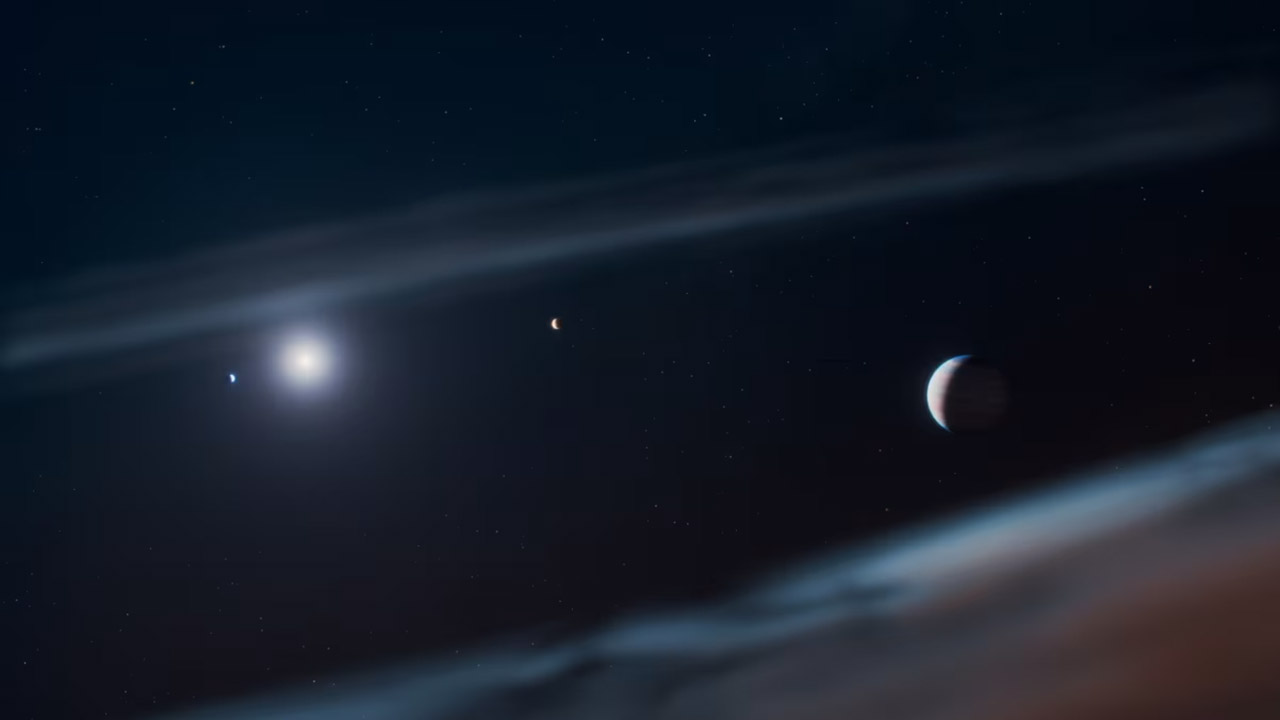
Beta Pictoris b was already a well-known object before astronomers pointed a radio telescope at it. When they first saw the planet in 2008, it was only a faint point of light next to a young star in the Pictor constellation. That star is approximately 1.75 times heavier than our Sun and only roughly 23 million years old. The planet is a bit larger than Jupiter and roughly 12 times as massive, taking nearly 24 years to complete an orbit that carries it as far as 0.55 arcseconds (a tiny measure of angular distance) from its star. Beta Pictoris c and d are two smaller gas giants in the same system, and the star is surrounded by a vast disk of dust and comets, which plays an important role in the drama. The fact that the star is rather quiet at radio wavelengths, along with the planet’s large separation, made it a more or less realistic target for astronomers. Previous searches have detected radio signals from brown dwarfs and planets in our own solar system, but had not been as clear about planets beyond our system.

LEGO Icons Hubble Space Telescope 11382
- EXPLORE THE HUBBLE SPACE TELESCOPE – Celebrate one of humanity’s greatest scientific feats while enjoying a relaxing building experience with the…
- REPLICA SPACE MODEL – Recreate the legendary space-based telescope with posable solar arrays and antennas, an opening aperture door and a detailed…
- AUTHENTIC DETAILS – Remove the exterior panels to reveal a detailed instrument bay, which features gyroscopes alongside primary and secondary…
Four MeerKAT runs in 2025 and 26 will split across the L and S bands, ranging from 0.85 to 3.5 gigahertz. During each of these experiments, a source was discovered directly above the Beta Pictoris system. A follow-up in May helped narrow it down even more by using quasars as markers in the sky for scientists to compare to, and by May, they were confident enough to locate the bursts on Beta Pictoris b. They appear in short, repetitive bursts that are very strongly polarized, around 70% in the highest frequency detection, with a continuous glow beneath it all. The pattern is similar to that of an A-type star, such as Beta Pictoris, although it is not possible. Berger’s group even recorded the same signal on successive nites and at different frequencies, so by the time this publication is read, they may be fairly certain it is on Beta Pictoris B.
Berger’s team’s success was actually due to frequency. Auroral radio waves of this type originate from the electron cyclotron maser, the same process that causes Jupiter’s radio storms and the northern lights on Earth. The peak frequency is directly proportional to the strength of the magnetic field at the source, approximately 2.8 gigahertz for every kilogauss. If a burst is still detectable at 3.5 gigahertz, which is the top of the observation band, you know the field strength must be at least 1.25 kilogauss (1,250 gauss) at the signal source. The Earth’s magnetic field is roughly 0.5 gauss, whereas Jupiter’s reaches up to 14 gauss, hence Beta Pictoris b is much ahead of both in terms of magnetic field strength. That number also appears to be consistent with what we would expect from a very young, enormous gas giant with a hot and fast-moving interior. Berger has stated that signals at these frequencies require an extremely strong field, and the team will be returning to MeerKAT to examine how that magnetic field behaves.
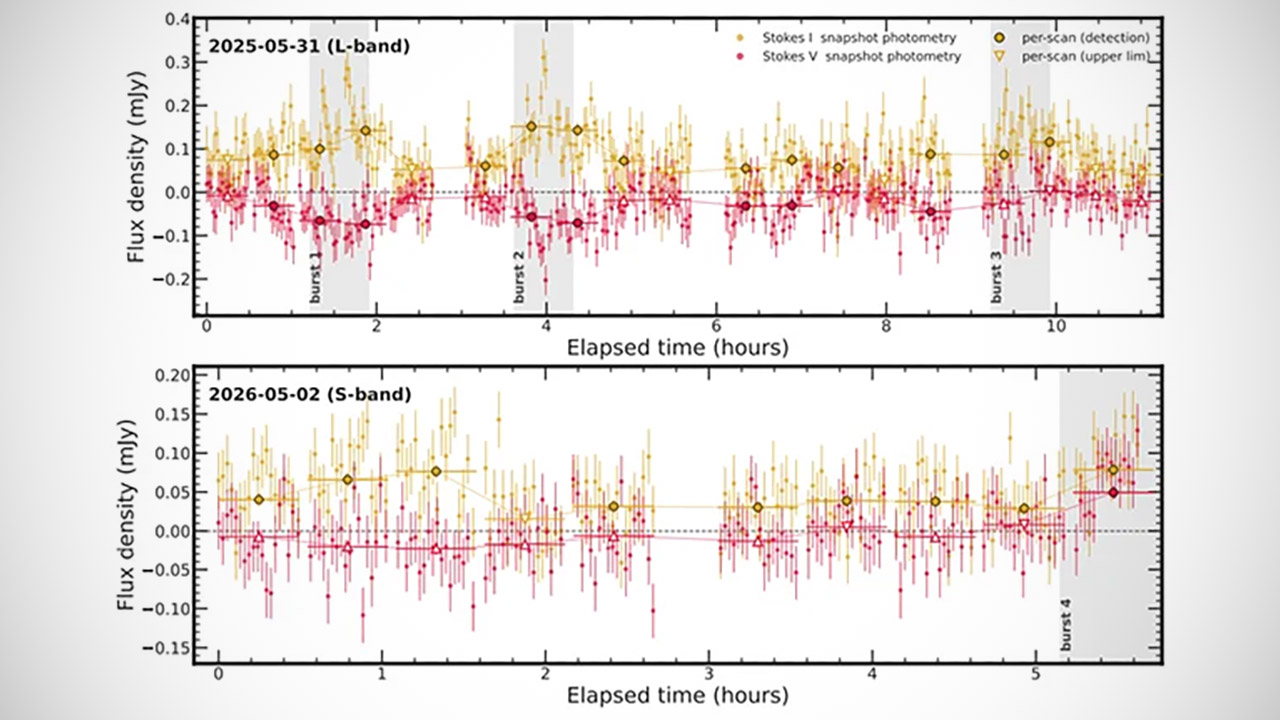
A field this strong would be more than adequate to direct charged particles and form any aurora that appears at the poles, as well as determine how much atmosphere is torn away by the stellar wind. For a gas giant so young, the measurement they obtained is the closest you can get to a direct look inside the planet’s dynamo system without having to rely on a model created from transit data or spectra. Getting the same kind of measurement on smaller or more distant gas giants will require much better arrays, nothing less. The authors believe it will require a five to sevenfold increase in sensitivity, as expected from the new generation of radio telescopes, to bring these other big planets within range. Until a new generation of dishes is created, Beta Pictoris B remains the sole world beyond our Sun whose magnetic field can be read directly from the radio waves it emits.
[Source]
MeerKAT Picks Up the First Radio Signal Ever Heard From Beta Pictoris b
#MeerKAT #Picks #Radio #Signal #Heard #Beta #Pictoris