James Webb Finds Two Rare Gravitational Mirrors in Cluster MACS J0454.1-0300
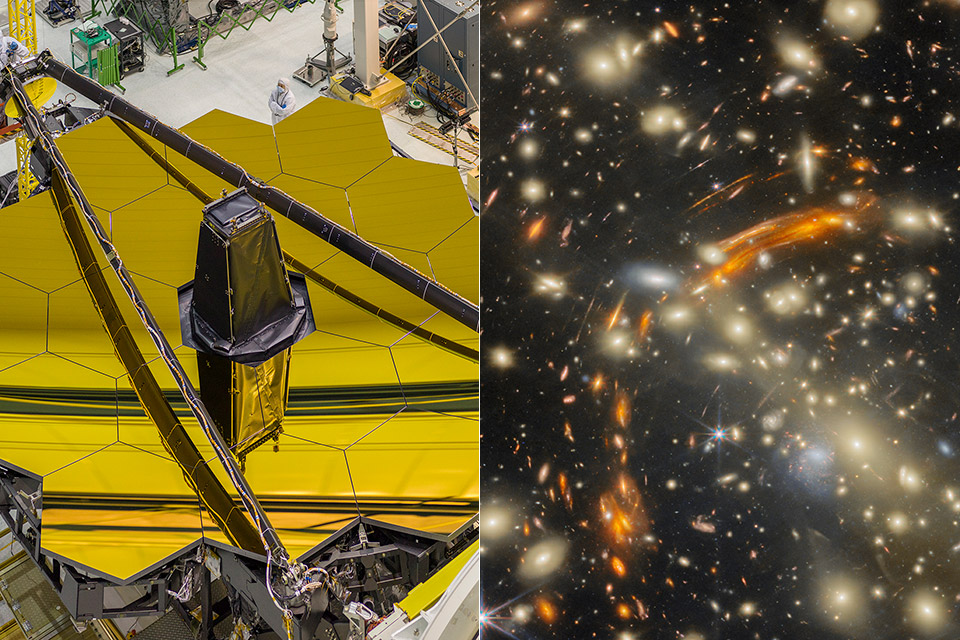
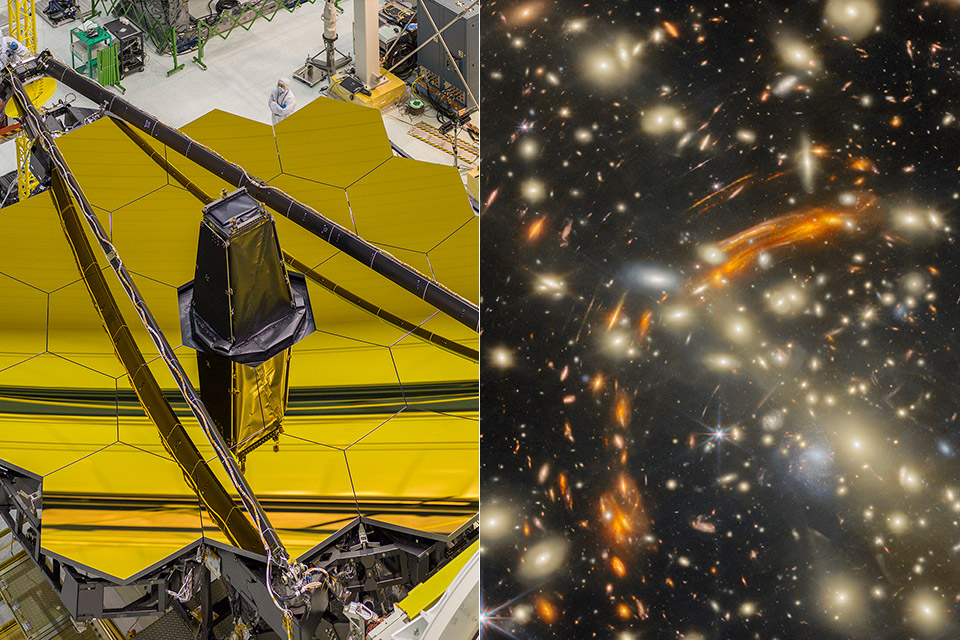
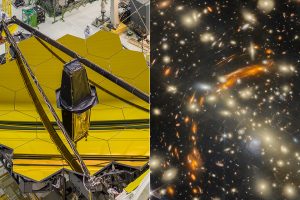
Golden elliptical galaxies fill the middle of the newest James Webb Picture of the Month, released this morning. They belong to the cluster MACS J0454.1-0300. Orange galaxies crowd one side of the frame and stretch into a broad arc around the brightest central members, while smaller reddish objects bend into short arcs even near the edges. A handful of bluish-white galaxies and a pair of sharp foreground stars sit in front of all of it.
Light from those gold-tinged galaxies has been on its way for so long that the cluster looks to be unchanged since the cosmos was only eight billion years old. Astronomers estimate that the cluster is a stunning five billion light-years from Earth. The orange galaxies posing as members of MACS J0454.1-0300 are actually sitting far away and happen to line up with the cluster when we look at it. Mass on the scale of a galaxy cluster warps the space surrounding it, causing light from anything behind that mass to curve and arrive as two copies, four copies, or a smear of arcs. Clusters operate well as lenses because they have so much mass, including the invisible dark matter that accounts for the majority of their weight. The Webb telescope’s huge 6.5-metre mirror and capacity to gaze into redder wavelengths allow us to leverage that bend to investigate things that would otherwise be invisible to us.

LEGO Icons Hubble Space Telescope 11382
- EXPLORE THE HUBBLE SPACE TELESCOPE – Celebrate one of humanity’s greatest scientific feats while enjoying a relaxing building experience with the…
- REPLICA SPACE MODEL – Recreate the legendary space-based telescope with posable solar arrays and antennas, an opening aperture door and a detailed…
- AUTHENTIC DETAILS – Remove the exterior panels to reveal a detailed instrument bay, which features gyroscopes alongside primary and secondary…
Four or more copies of the same background galaxy appear in only 10 to 20 percent of clusters, simply because the background object and foreground mass must be perfectly aligned. These researchers got lucky and discovered that layout twice in just one cluster, which is the first time this has happened for several items in the same domain. One set of duplicates belongs to a group of galaxies that were formed roughly two billion years after the Big Bang, and they appear to be merging, resulting in a massive burst of star production. Another group belongs to a single galaxy that existed only 800 million years after the Big Bang.
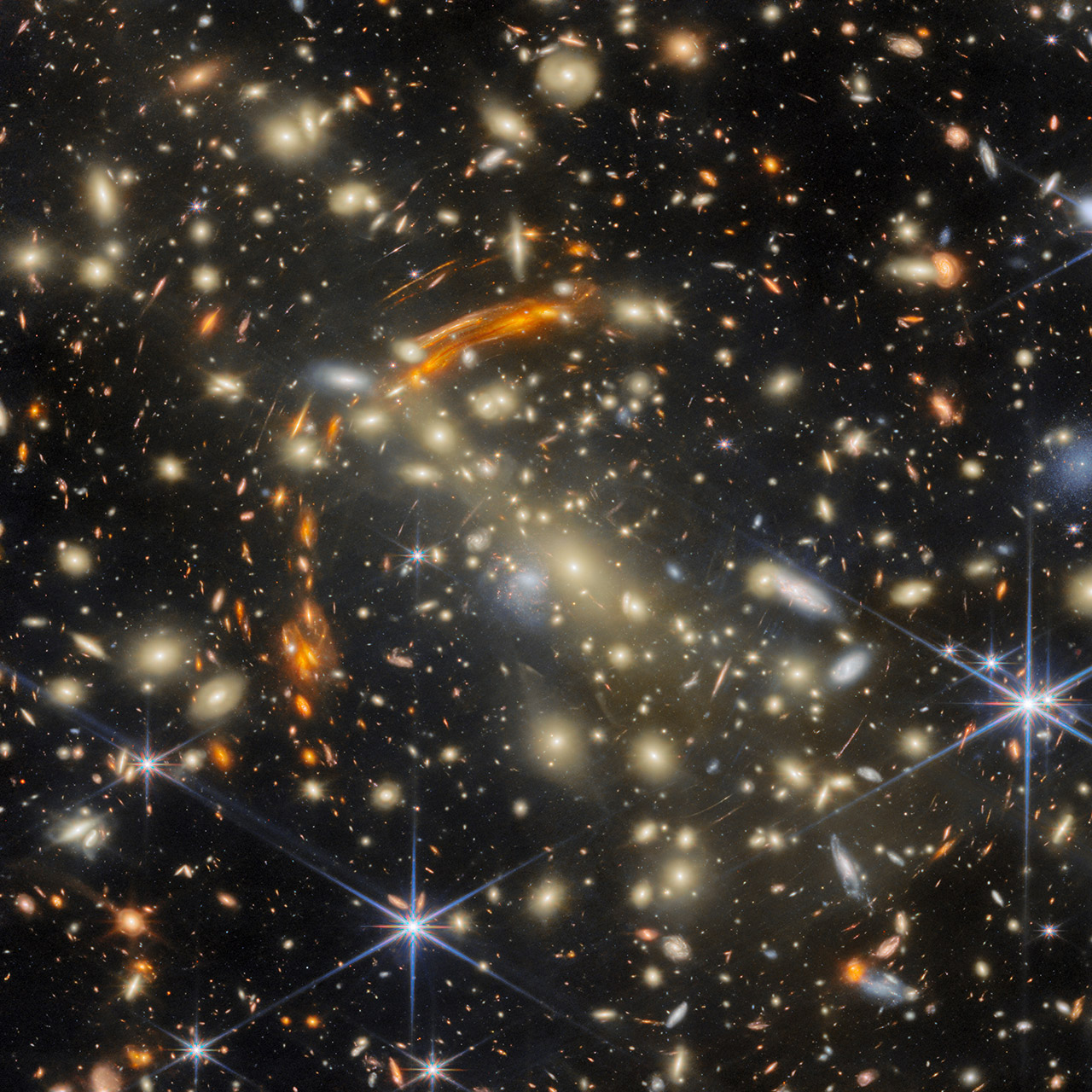
Some of the bright spots inside those lensed regions are small (relatively speaking), only around five light-years across, yet the cluster magnifies them by more than 300 times. NIRCam created this color image using a stack of filters ranging from 900 nanometers to 4 micrometers, which is why the cluster members appear to be made of gold while the distant galaxies are painted a deep orange.
Hubble snapped a photo of the same cluster back in 2014. Both frames show two bright stars from our own galaxy and a fuzzy white galaxy near the center, but the older Hubble image shows hundreds of other galaxies that are not visible this time because Webb was able to detect their much redder light in far greater detail. Data was provided by no less than two observing programs, including Furtak’s Program 5058, which tries to identify individual lensed stars from the first billion years by scanning one enlarged galaxy for any single stars that briefly become brighter in the process. Fujimoto’s Program 6882 examines clusters at various wavelengths to determine how star formation began and how the first galaxies grew. Suddenly, MACS J0454.1-0300 provides both of these efforts with a lens that copies the early universe twice in the same frame.
James Webb Finds Two Rare Gravitational Mirrors in Cluster MACS J0454.1-0300
#James #Webb #Finds #Rare #Gravitational #Mirrors #Cluster #MACS #J0454.10300