Iran’s Supreme Leader Ayatollah Ali Khamenei killed in strikes, led theocratic regime for decades
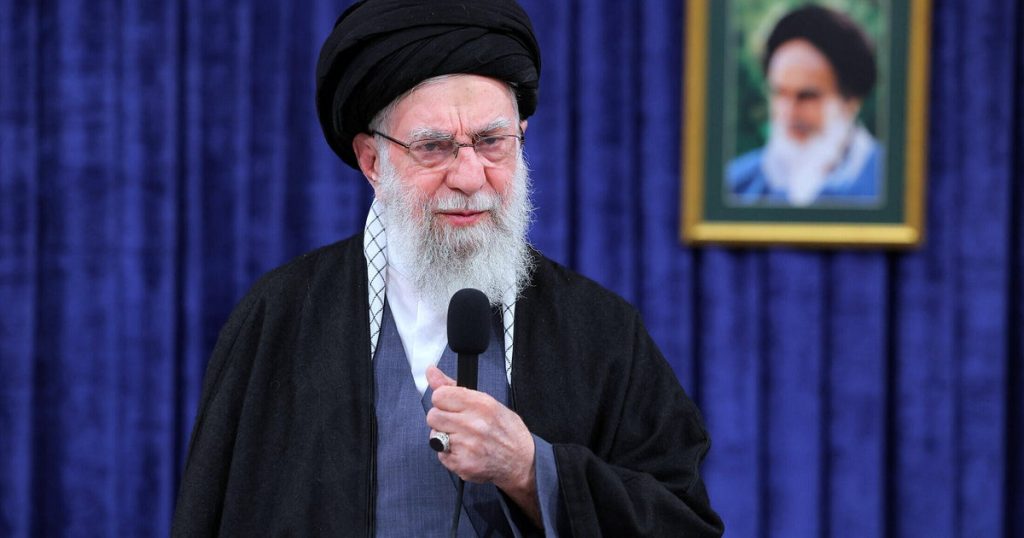
Iranian Supreme Leader Ayatollah Ali Khamenei was killed after a massive U.S. and Israeli military operation Saturday, President Trump said, joining multiple Israeli official sources and a senior U.S. intelligence official who had confirmed the news to CBS News.
“Khamenei, one of the most evil people in History, is dead,” Mr. Trump posted on social media.
He added that the U.S. government is “hearing that many of their IRGC, Military, and other Security and Police Forces, no longer want to fight, and are looking for Immunity from us.”
Mr. Trump continued that the “heavy and pinpoint bombing, however, will continue, uninterrupted throughout the week or, as long as necessary to achieve our objective of PEACE THROUGHOUT THE MIDDLE EAST AND, INDEED, THE WORLD!”
Israeli Prime Minister Benjamin Netanyahu said earlier Saturday that there are “growing signs” that Khamenei is “gone” after the mission. When asked if Khamenei had been killed, Mr. Trump earlier told NBC News by phone on Saturday that he had “spoken to a lot of people beyond and we feel certain, we feel, we feel that that is a correct story.”
People are cheering in the streets of Tehran, according to a CBS News producer in Tehran. But the state media in Tehran has not confirmed Khamenei’s death, and neither has the Iranian Foreign Ministry.
The Free Press: This Is How the Islamic Republic Falls
An Israeli broadcaster said Saturday that Netanyahu had been shown a photo of Khamenei’s body.
Mr. Trump told NBC News that Khamenei “killed many people” and has “destroyed a country.”
“The people that make all the decisions, most of them are gone,” he said.
The Israel Defense Forces said in a press conference Saturday that seven Iranian officials and commanders were killed, including Ali Shamkhani, an adviser to Khamenei.
Khamenei, 86, had been Iran’s supreme leader since 1989, succeeding the leader of Iran’s 1979 revolution, Ayatollah Ruhollah Khomeini. Khamenei controlled all branches of the government and the military and was considered the spiritual leader. It’s unclear who will succeed him.
Pleiades Neo (c) Airbus DS 2026 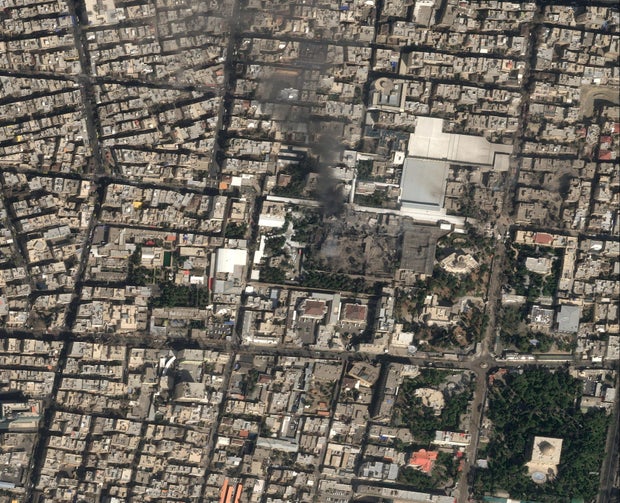
In Iran’s hierarchy, Khamenei had no one to answer to but God. On the job, however, he was a hostage to the powerful and competing political factions of his nation. Against the odds, he managed to keep them loyal for more than three decades — and they helped him enforce an Islamic regime the majority of Iranians no longer wanted.
The ayatollah backed the ruthless suppression of political dissent and turned a blind eye to corruption and abuse among those he relied on, especially the powerful Islamic Revolutionary Guard Corps.
“There’s corruption across the whole system,” said Sanam Vakil, director of the Middle East and North Africa Program at London’s Chatham House think tank, speaking to CBS News before the Iranian leader’s death. He described Khamenei as “a bit of a pragmatist,” someone who “understands the distribution of power, and that for this system to survive, you need loyalty and you need loyalists.”
Born in the northern city of Mashhad, Khamenei was the second of eight children. He was educated at various Islamic seminaries, and as a young man, he studied under the man who would become Iran’s first supreme leader, Ayatollah Ruholla Khomeini.
In 1979, like many clerics, he joined the Islamic Revolution that toppled the pro-Western regime of Iran’s royal family. He was brought into the ruling inner circle, serving briefly as the new Islamic Republic’s deputy defense minister and then two terms as Iran’s president between 1981 and 1989.
On June 4, 1989, following Ayatollah Khomeini’s death, Khamenei was elected by the country’s powerful Guardian Council of 88 Islamic scholars to be the new supreme leader. That made him commander-in-chief of the military and head of the executive, legislative and judicial branches of the government, as well as Iran’s ultimate religious authority.
He lacked the individual authority of his predecessor, however, so Khamenei built a network of allies and cronies to bolster his grip on power, including senior figures in the Revolutionary Guard.
In his book “Reading Khamenei,” Karim Sadjadpour of the Carnegie Endowment for International Peace wrote that the Iranian leader “handpicks the organization’s senior command and shuffles them regularly; he also oversaw the Guards’ rapid rise to become Iran’s most powerful political and economic institution.”
In 2003, Khamenei issued a fatwa — an indisputable religious edict — forbidding the production, stockpiling or use of weapons of mass destruction, on the grounds that it was forbidden by Islam.
But despite the public shunning of such weapons, he gave his implicit backing to the expansion of Iran’s nuclear program, which the country’s leaders have always maintained — unconvincingly — is solely for peaceful purposes.
Khamenei’s government boosted its stockpiles of near-weapons-grade uranium. A U.S. intelligence assessment from May 2025 said the country “almost certainly is not producing nuclear weapons, but Iran has undertaken activities in recent years that better position it to produce them, if it chooses to do so.” Netanyahu maintained Iran was perhaps only months to a year away from being able to build a bomb.
In the past year, Mr. Trump sought a deal with Iran to limit its nuclear program, after he removed the U.S. from a 2015 deal during his first term. Those talks proved challenging, with Mr. Trump saying Iran should not be allowed to enrich uranium — a demand Khamenei rejected. Mr. Trump has said Iran “must completely give up hopes of obtaining a Nuclear Weapon.” Netanyahu has long been skeptical of striking a deal with Iran.
When serious negotiations began during then-President Barack Obama’s first term on the nuclear deal, Khamenei made it clear he was skeptical of the talks with Western countries that he deemed untrustworthy, but he never actually condemned the dialogue.
“I am not optimistic about the negotiations, and they will lead nowhere,” he declared in a 2014 speech. “But I am not against them.”
It was typical of Khamenei’s gnomic pronouncements. They left plenty of wiggle room, so that, however things turned out, he could claim to have been right.
Only a tightly knit group of insiders with access to his guarded compound knew what he really thought. Khamenei never traveled outside of Iran during his long reign as supreme leader, and never gave an interview.
Perhaps it was feared that public exposure would have diminished his mystique and authority.
Khamenei came of age during the era of pushback against British and American influence over Iran’s vast oil resources. He blamed the U.S. for the CIA-backed coup that brought down Iran’s democratic government in 1953, and for supporting the autocratic regime of Shah Reza Pahlavi.
In 1979, he supported the students who held 52 Americans hostage for more than 444 days and, over the following decades, his dislike and distrust of the United States only grew.
Almost three decades after taking over as Iran’s supreme leader, Khamenei declared America “the number one enemy of our nation.”
In 2018, when Mr. Trump unilaterally pulled the U.S. out of the international nuclear agreement with Iran that was negotiated under his predecessor, Khamenei turned it into an I-told-you-so moment, holding it up as evidence that Washington could not be trusted.
But many in the country wouldn’t trust him, either.
The year after the nuclear pact began unraveling, and in the years since, young Iranians bitterly opposed to their country’s clerical rulers took to the streets, carrying posters bearing the once unthinkable slogan: “Death to the supreme leader.”
“The people’s sense of loyalty to the revolution and the Islamic ideology of the revolution declined significantly while Khamenei was leader,” said Vakil. “At the same time, the economic power of Iran declined significantly, so obviously he lost a massive amount of legitimacy with his people.”
Rather than engage with their concerns or consider liberal reforms, however, Khamenei doubled down. He blamed the country’s dismal economy and the domestic unrest on the U.S. and its ally Israel, and gave his tacit blessing to the violent suppression of protests, even as security forces killed some of the demonstrators.
In 2014, Khamenei’s office released pictures of the leader in a hospital recovering from prostate surgery, prompting constant rumors about his deteriorating health.
But he hung on for nearly 12 more years — the unflinching overlord of revolutionary ideals that were more and more out of step with a modernizing Iran.
Iran’s Supreme Leader Ayatollah Ali Khamenei killed in strikes, led theocratic regime for decades
#Irans #Supreme #Leader #Ayatollah #Ali #Khamenei #killed #strikes #led #theocratic #regime #decades