Lawmakers seek crackdown on China-owned U.S. farmland as Trump meets with Xi Jinping
President Trump’s face-to-face meeting this week with Chinese President Xi Jinping comes as members of Congress are calling for a crackdown on China’s ability to acquire U.S. farmland, citing national security concerns.
Mr. Trump arrived in Beijing on Wednesday for a highly anticipated summit with Xi, which is expected to focus on trade, energy, Taiwan and the war with Iran. Ahead of his visit, a bipartisan group of lawmakers introduced new legislation that aims to close what they described as “dangerous loopholes” allowing foreign adversaries like China to purchase American farmland and real estate near U.S. military bases.
“Food security is national security, and we cannot allow foreign adversaries like China to buy up American farmland near our most sensitive military and critical infrastructure sites,” Rep. John Moolenaar, a Michigan Republican who heads the Select Committee on China and led the bill’s introduction, said in a statement.
The bill has backing from members of both parties, with Democrats such as New Jersey Rep. Josh Gottheimer and California Reps. Julia Brownley, Jimmy Panetta and Mike Thompson signing on.
A Trump administration official told CBS News that tracking foreign land ownership continues to be a priority, including reviewing how states compile data on the matter.
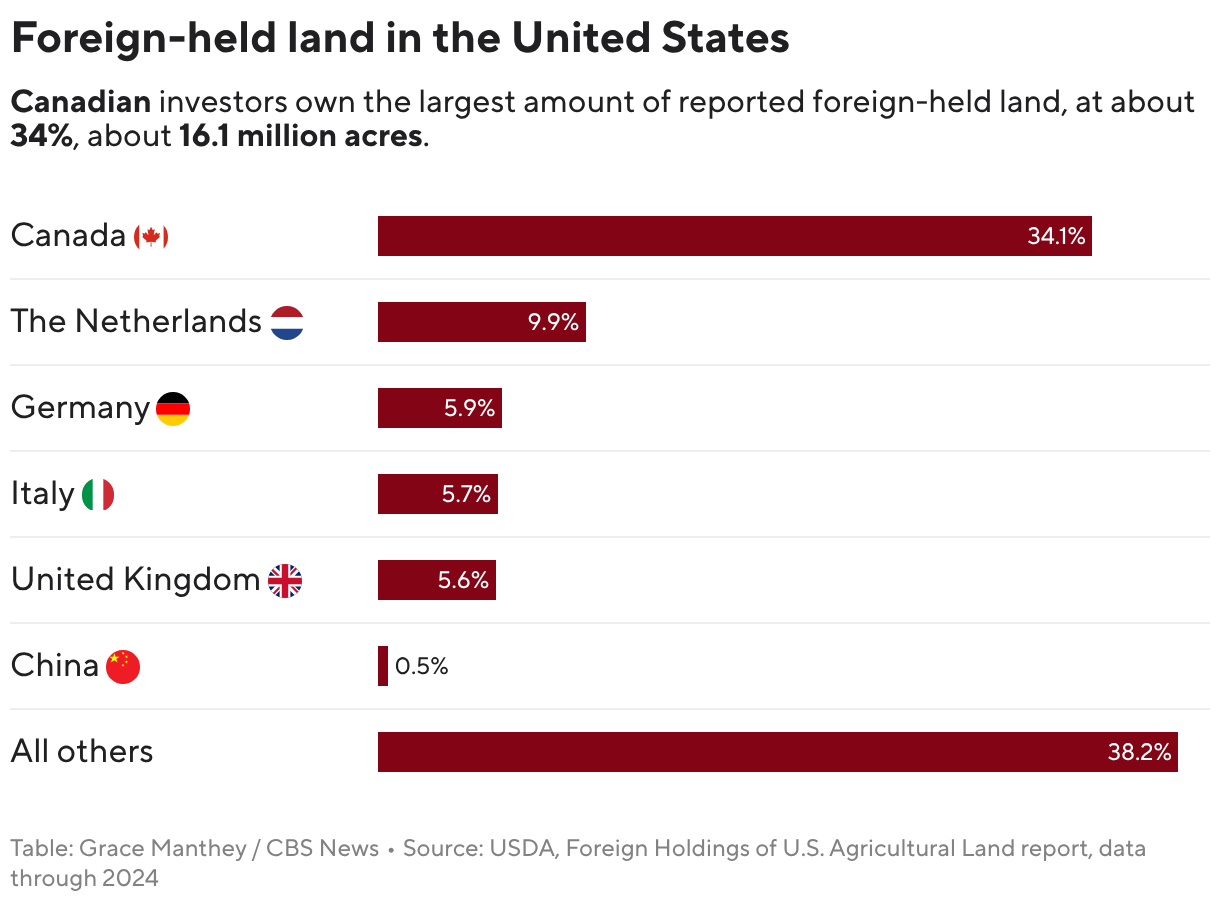
More than 40 million acres of agricultural land in the U.S., about 2% of the nation’s total, is owned by foreign entities, according to the latest assessment by the Department of Agriculture as of December 2024. Chinese investments amount to less than 1% of foreign-held land in the U.S.
Last February, President Trump signed a national security memorandum that sought to restrict Chinese investments in strategic U.S. sectors, including technology, healthcare and agriculture. White House spokesperson Olivia Wales told CBS News that Mr. Trump “is committed to making the United States a premier destination for investment while balancing national security interests — ensuring that America’s future remains firmly in American hands.”
“President Trump’s upcoming meeting with President Xi will advance these goals with a clear-eyed view of the economic and security realities of today,” she added.
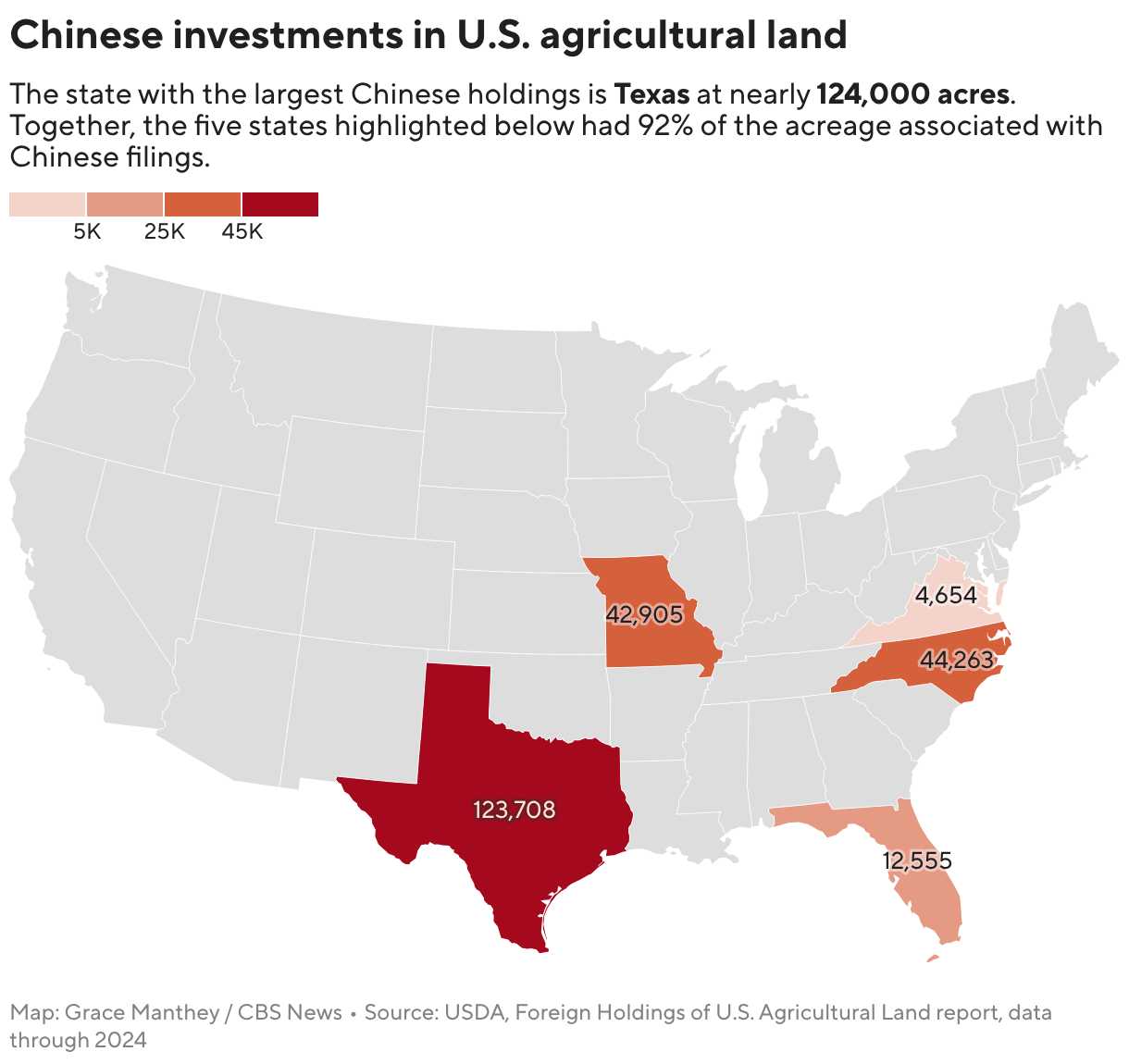
USDA has previously reported that the states with the largest Chinese holdings include Texas (123,708 acres), followed by North Carolina (44,263 acres); Missouri (42,905 acres); Florida (12,555 acres); and Virginia (4,654 acres).
The Virginia-based Smithfield Foods Inc., one of the largest pork producers in the world, was bought by a Chinese meat company in 2013 for billions of dollars. Now, Smithfield Inc. is the second largest Chinese holder of agricultural land in U.S., with tens of thousands of acres, according to USDA.
Scott Lincicome, the vice president of general economics at the Cato Institute, a libertarian think tank, told CBS News he believes the congressional concerns about Chinese investments are overblown.
“If you look at the latest data from the USDA, Chinese ownership of farmland is a tiny, tiny sliver of all U.S. farmland,” Lincicome said.
He acknowledged there is a “justifiable security argument” when it comes to Chinese land ownership in close proximity to military bases, but added there needs to be further evidence to warrant restricting property rights.
“We always, always have to remember that in the vast majority of these farmland transactions, the seller is an American,” he said. “So this is the federal government restricting the property rights of American citizens.”
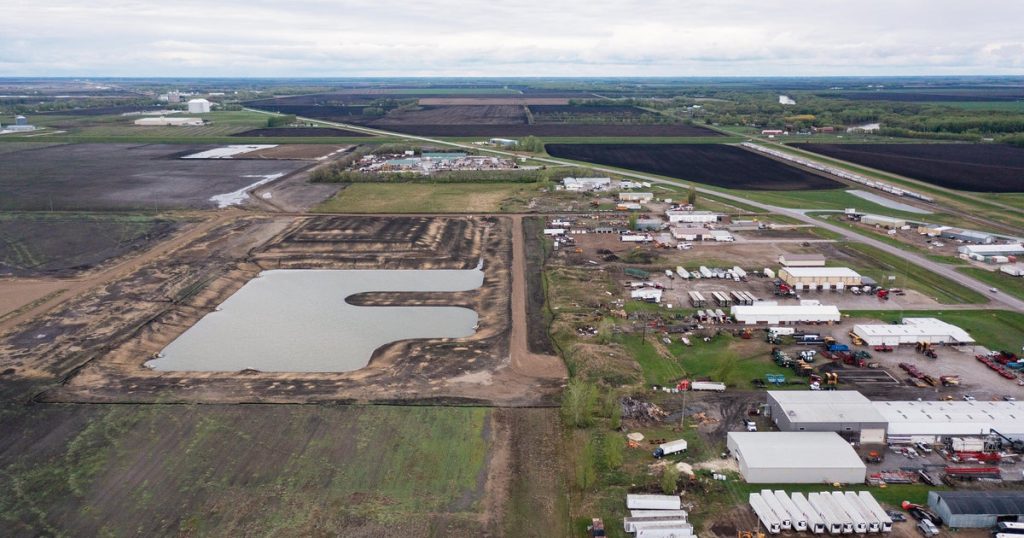
CBS News previously reported that China-linked acquisitions near U.S. military bases have sparked national security concerns — prompting lawmakers in North Dakota in 2023 to block a Chinese company from building a corn mill near an Air Force base in Grand Forks.
Ben Brewer / Bloomberg via Getty Images 
Moolenaar’s bill, if passed, would require the Treasury Department’s Committee on Foreign Investment in the U.S. to review land purchases that involve China, Russia or other foreign adversaries. The office ruled in 2022 that it had no jurisdiction over a Chinese company’s purchase of farmland in North Dakota near Cavalier Space Force Station and Grand Forks Air Force Base.
“Huge data reporting gaps” have made getting a full picture of foreign investment in the U.S. difficult, David Feith, a former national security official who worked in the State Department on U.S.-China policy during the first Trump administration, told CBS News. He described the data as “very incomplete.”
The Government Accountability Office, an independent and nonpartisan agency, found in January 2024 that the USDA “needs to collect, track, and share the data better,” citing its reliance on paper forms filed in state counties. Without “improving its internal processes, USDA cannot report reliable information to Congress or the public about where and how much U.S. agricultural land is held by foreign persons,” the office said in the report.
A USDA official told CBS News that the agency has taken steps to strengthen mandatory disclosure of foreign transactions, citing an online portal for reports and an online form for the public to submit information.
Data for 2025 “should be available in late 2026,” the official said.
Dozens of states now have laws on the books “that seek to restrict to some degree foreign ownership or investments in private agricultural land within the boundaries of their state,” according to the National Agricultural Law Center. Efforts have picked up in recent years to limit ownership, including in Utah, where its Republican governor, Spencer Cox, signed a bill into law that expanded previous foreign restrictions.
That effort disrupted a land sale in Utah near Provo Airport to Cirrus Aircraft, a company that is majority-owned by the Chinese state-owned Aviation Industry Corporation of China. The Agriculture Department and American Farm Bureau previously said that roughly 34,000 acres in Utah has been owned by Chinese investors and companies.
“Total farmland owned by Chinese Communist Party entities may be small in aggregate — but that isn’t what matters,” Michael Sobolik, a senior fellow at the right-leaning Hudson Institute who specializes in U.S.–China relations, told CBS News, adding that lawmakers’ concerns relate to the properties’ “proximity to sensitive locations.”
“That’s why we need to take this issue seriously, and it’s good that Moolenaar is doing that,” he said.
Lawmakers seek crackdown on China-owned U.S. farmland as Trump meets with Xi Jinping
#Lawmakers #seek #crackdown #Chinaowned #U.S #farmland #Trump #meets #Jinping